At the ancient site of Ur in southern Iraq, a carved stone cylinder gives a woman in a burial chamber her name. Puabi’s jewelry might have told excavators that she belonged among the city’s highest-ranking people. The signs on the seal made it possible to speak about a particular person. Nearby graves yielded musical instruments, inlaid objects, and evidence of communal burial that archaeologists still investigate. Taken together, the finds show a city where skilled workers, powerful households, and elaborate religious practices were already part of urban life centuries before the usual historical setting proposed for Abraham.
What you’ll learn
- How Leonard Woolley’s team found Puabi’s tomb and how a cylinder seal identifies her.
- What the Standard of Ur, the burial pits, and the latest examination of human remains tell us about life and death in the city.
- Why archaeologists often identify this site with the Ur of Genesis and how the graves give context to Abraham’s departure.
How the cemetery came to light
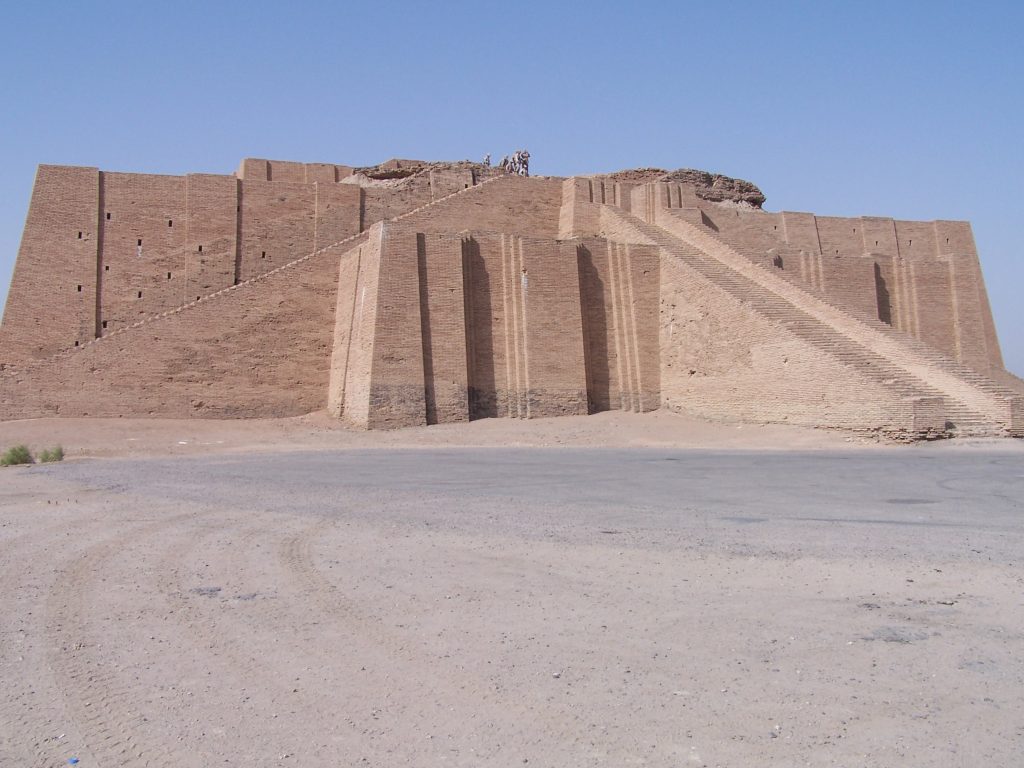
Tell el-Muqayyar lies in the alluvial country of southern Iraq, near modern Nasiriyah. In antiquity, rivers and canals linked the city to a much wider region. The visible mound includes remains of many periods, and the ruined brick monument that dominates the site today does not date the buried cemetery. The great ziggurat was begun under Ur-Nammu near the end of the third millennium BC. The richest graves discussed here generally belong to an earlier phase around the middle of that millennium. At a site occupied for so long, a person crossing the mound on foot can pass above centuries of different settlements and construction. Penn Museum collection overview.
The British Museum and the University of Pennsylvania jointly excavated Ur from 1922 to 1934 under Leonard Woolley. The principal cemetery report covers graves excavated from 1926 to 1931. The team recorded roughly eighteen hundred burials and called sixteen royal. The word describes Woolley’s archaeological category, based on a combination of evidence such as constructed chambers, unusually rich possessions, and groups of additional bodies. The excavators could recognize an unequal distribution of wealth even among graves with no inscribed identifying object. A large burial might once have been badly plundered, while a smaller one could preserve delicate details that larger graves lost. The classification began with a practical question about what survived in the soil. Woolley’s published Ur excavation volumes.
A grave designation such as PG 800 allows the reader to follow a specific find after the collection was divided between museums. Shape and decoration can be seen in a display case. The archaeological record gives the display information it cannot supply on its own, including whether an object lay on the body, beside furniture, or in a pit beyond the chamber. Ancient robbing, the decay of wood, and later damage may all affect this record. The field drawings and catalogues therefore matter as much as the photographs. In a well-recorded burial they allow another investigator to ask new questions of the excavation decades after it closed.
A queen in the burial register
Woolley’s team reached Puabi’s burial in the 1927–28 season. On January 4, 1928, Woolley reported the discovery in a telegram written in Latin. The body lay in a built and vaulted chamber. On the person and around her were gold ornaments, stone beads, and vessels. The labels from the excavation use an older reading of her name, which is why early reports call her Shubad. A cylinder seal from beside the body bears the signs now read as Puabi and a title commonly translated as queen or lady. The title tells us how she was identified by someone in her own world, while the chamber and goods show how her household marked her death. Penn Museum’s headdress and field account.
The seal’s banquet imagery also helps explain why a cylinder was useful. Pressing and rolling the incised stone over clay produced a continuous impression. A museum photograph allows us to study the carved object, and a rolling or cast impression gives the composition in the order an ancient user could see it on clay. There is a further historical detail in the words that survive. Puabi’s name is accompanied by her title without an identifiable husband on this seal. That makes her rank visible in her own right, while the precise form of power she exercised remains difficult to reconstruct. The inscriptions and the burial give scholars a stronger basis for identifying her than they give for writing a biography. Penn Museum object record for B16728.
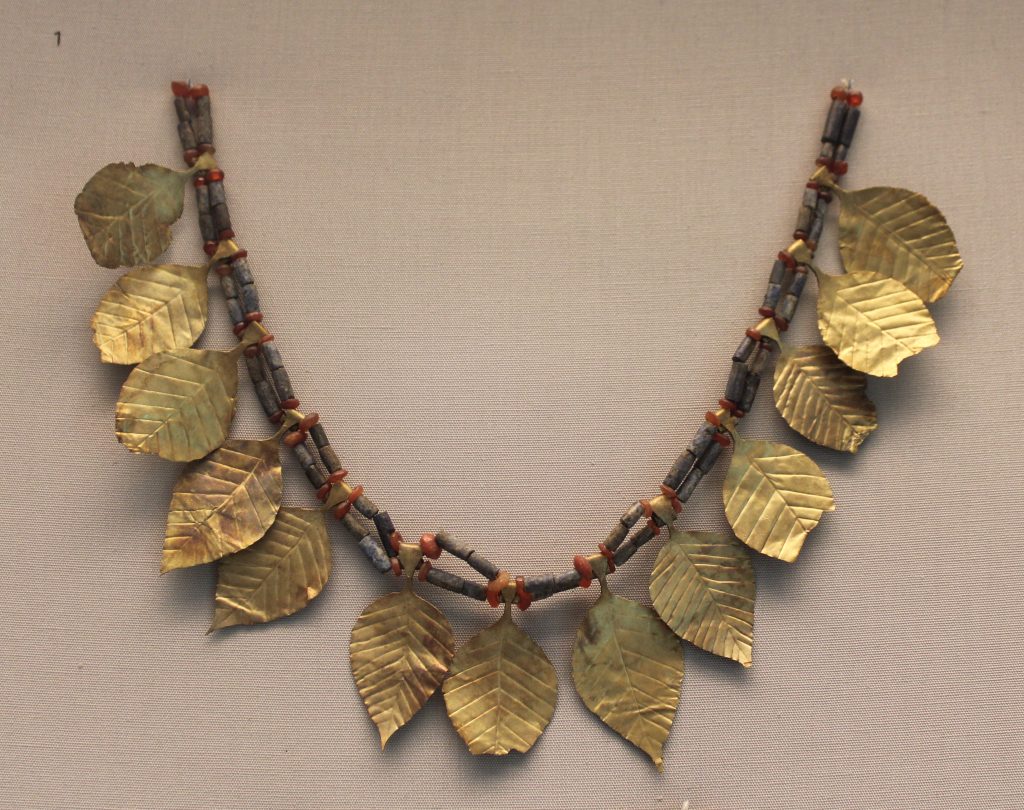
Gold leaves, strings of lapis lazuli and carnelian, and a wide comb make the head ornaments especially distinctive. Many organic fastenings or supports disappeared. Their placement must be reconstructed from positions recorded during excavation and from the surviving parts. When a museum mannequin wears the full arrangement, its appearance reflects both ancient work and a modern act of interpretation. The notes make it possible to tell which pieces were found on different people and which were recovered from a table or another part of the room. That is worth checking even in the same photograph gallery, because Puabi’s burial included richly dressed attendants as well as the person to whom the tomb is attributed.
What the burials and objects can tell us
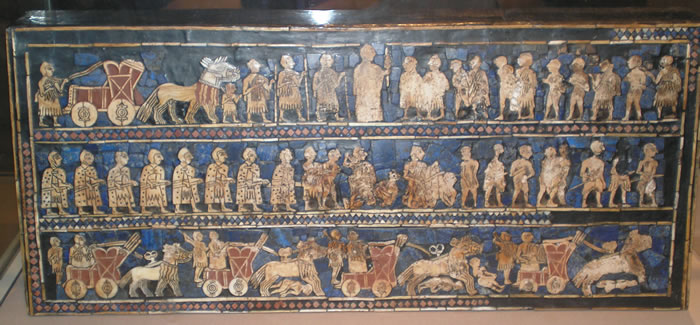
The object known as the Standard of Ur belongs to a different grave, PG 779. It has two long panels with figures in horizontal registers. In one scene, vehicles and soldiers move through battle, and captives are brought before a prominent figure. Another panel shows goods being carried and a banquet with music. Those are observations about the images. The modern name reflects an early guess about how the object might have been used. Its wooden structure decayed, and the surviving inlays had to be recovered and put back together. The materials and workmanship therefore tell a clearer story than the object’s original job. British Museum collection entry for 1928,1010.3.
The excavators found human remains outside some principal chambers as well as inside them. The arranged positions of bodies originally led Woolley to picture attendants taking a fatal drink and lying down together. A later study examined two skulls, from two separate graves, using imaging and forensic methods. The researchers found injuries consistent with lethal blunt force and proposed that the bodies had been treated after death before being placed in the burial. The sample was small. Historians can use it to revise the earlier account of how at least some people died, while leaving open how widely the practice extended and what the participants understood about it. Baadsgaard and colleagues’ study of the remains.
Puabi’s seal preserves the name of one person. The burial beside her preserves traces of people whose names the excavators could never recover.
Objects also acquired new names after they were dug up. Woolley called a pair of figures from the Great Death Pit rams in a thicket, recalling the animal Abraham offers in Genesis 22. One is now in the Penn Museum. The figure is a caprid standing upright at a plant, made with gold, shell, lapis lazuli, and other materials. Its name belongs to the history of the excavation and tells us what the excavator thought of when he looked at it. Its burial context and imagery connect it to Ur. Genesis places the offering in a different setting, much later in the story of Abraham and Isaac. Penn Museum’s object account and description of Woolley’s naming.
Ur in Genesis
Genesis 11 introduces Abram within Terah’s family and names Ur of the Chaldeans as the place the family left. Genesis 11:31 describes Terah taking Abram, Sarai, and Lot with Canaan in view. The family settled in Haran. Genesis 12 then describes the Lord’s call and Abram going on from Haran with Sarai and Lot. When reading the two chapters together, the move from Ur and the onward departure from Haran are distinct stages. Readers can trace that sequence in the text before drawing a line across a modern map. Genesis names the places important to the account without giving the family’s daily itinerary.
The city Woolley excavated is conventionally identified with the Ur named in Genesis. It can be securely described as the ancient Mesopotamian city of Ur, and its location in the southern alluvial region fits a later geographical association with the Chaldeans. The exact biblical identification is debated, and northern alternatives have been proposed, in part because other places associated with Abraham’s family lie to the north. The cemetery contains no text linking an excavated grave to Abraham’s household. Its mid-third-millennium dating is also considerably earlier than the second-millennium settings often proposed for the patriarchs. The discovery tells us what one prominent Mesopotamian city was capable of well before the journey recorded in Genesis.
For Christian readers, the call of Abraham remains the center of the account. In Joshua 24:2–3, Joshua reminds Israel that its ancestors once lived beyond the Euphrates and served other gods, and that the Lord took Abraham from there and led him into Canaan. Hebrews 11:8–10 reads the departure as an act of faith and describes Abraham looking forward to a city founded by God. Excavations at Ur make the built cities of the ancient world easier to picture. They give texture to the networks of kinship, status, trade, and worship in the world from which God called him. See also the Hammurabi stele and the background of Mesopotamian public life.
See Ur in the field
In the Penn Museum video, start with the view of the ziggurat and the surrounding landscape. Then return to the photographs of the smaller objects. The site and its portable finds preserve evidence at very different scales. A monument can help place Ur on the landscape and show the resources available to its builders. A seal or piece of jewelry can place a person within a room and show how an excavator reached that conclusion. Keeping the scales together gives us an older city with inhabitants, workshops, and households. It also helps explain why the line in Genesis about a family going out from Ur carries real geographical weight.
Sources and further reading
- Ur, Iraq — Penn Museum overview and collections.
- Queen Puabi’s Headdress — Penn Museum field and cataloguing evidence for PG 800.
- Published field reports — Woolley and the joint expedition’s reports.
- Puabi’s cylinder seal B16728 — Penn Museum object record and reading.
- The Standard of Ur — British Museum object record for the inlaid box.
- Studies of the royal remains — Primary study of the two sampled skulls.
- Ram in the Thicket — Penn Museum artifact account and the object’s modern nickname.
- Ur site film — Penn Museum-hosted video and context.