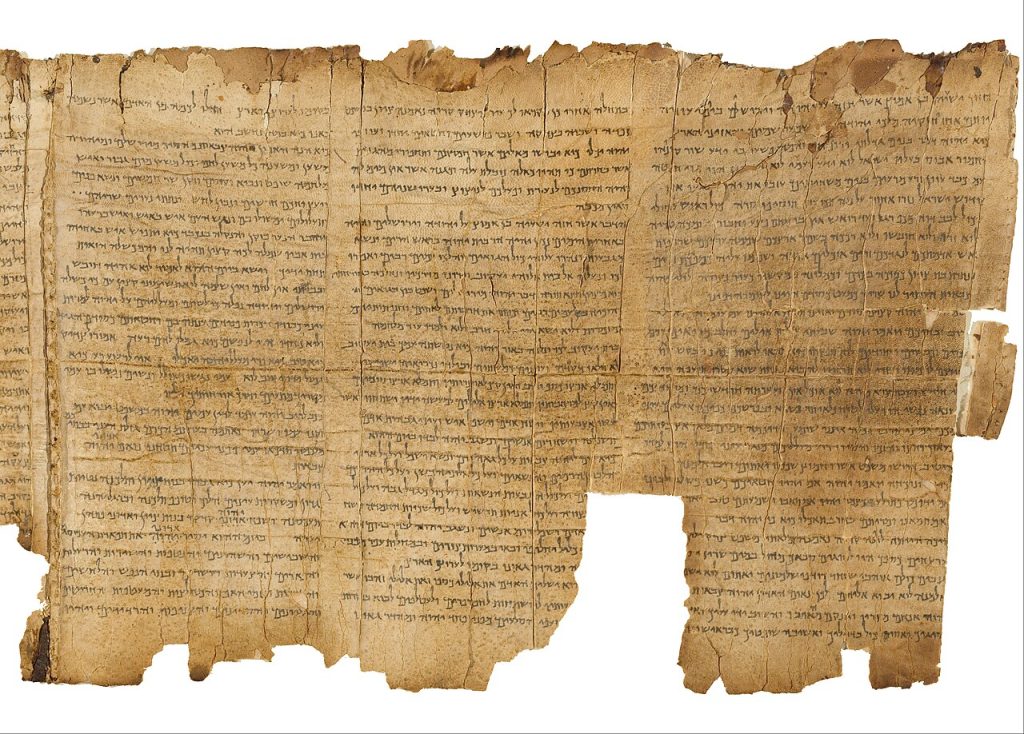
Take the longest surviving Dead Sea Scroll out of its modern case in your imagination and follow its writing for more than eight meters. A reader encounters laws for the temple, a calendar of offerings, and rules about matters as different as the appointment of judges and the responsibilities of a king. The work is written in Hebrew and closely engages the Torah. It also adds instructions and combines passages in ways that reveal what one ancient writer or circle of writers hoped the life of Israel could look like. This is the Temple Scroll, cataloged as 11Q19. Its discovery lets us study the world of people who read the biblical laws and asked how those laws should govern a sanctuary, a city, and a nation. Israel Museum, Envisioning the Temple.
Key takeaways
- The principal Temple Scroll is 11Q19, a Hebrew manuscript associated with Qumran Cave 11 and normally dated around the turn of the era.
- Many scholars place the composition’s earlier development in the Hasmonean period. The date of a surviving copy and the date of the work are different questions.
- The document sets older biblical material beside an expanded temple plan, offerings, purity rules, and civil law.
- An unusual mineral layer on the parchment provides separate evidence for how its makers prepared the writing surface.
A cave discovery and a long road to publication
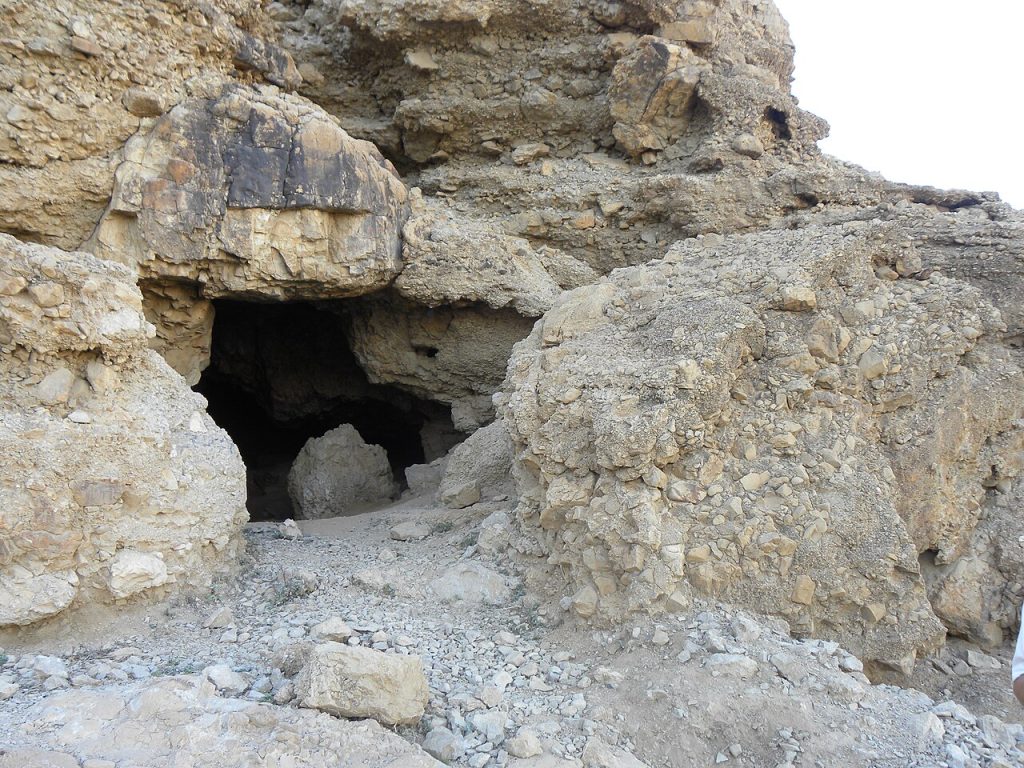
Cave 11 lies north of the settlement called Khirbet Qumran. The Israel Museum’s digital project associates the principal Temple Scroll with its discovery in 1956, using cautious language because the earliest handling of the manuscript is less fully documented than an excavated object kept in a numbered field deposit. The scroll passed through the antiquities trade and came into Yigael Yadin’s hands in 1967. Yadin announced it that year and prepared a full Hebrew edition published in 1977. These dates describe different moments in the object’s history. The cave discovery, the recovery of the roll for study, and the publication that allowed other people to check readings took place years apart. Israel Museum Digital Dead Sea Scrolls. Yadin’s 1967 announcement. Israel Exploration Society’s edition record.
It is worth distinguishing the full-sized roll from the other pieces that bear related writing. In the catalog number 11Q19, 11Q points to Qumran Cave 11, and 19 identifies this particular manuscript. 11Q20 refers to a different, fragmentary copy with overlapping text. Related manuscripts have also been studied in connection with the Temple Scroll, and specialists continue to work on which represent copies of the composition and which may preserve different related material. That is why a publication’s diagram of the scroll and a museum photograph can legitimately look different even when both use the title Temple Scroll. The label can refer to the literary work or to a particular physical witness. Israel Antiquities Authority plate catalog, including 11Q20. Lawrence Schiffman and Andrew Gross’s edition of the scroll and related manuscripts.
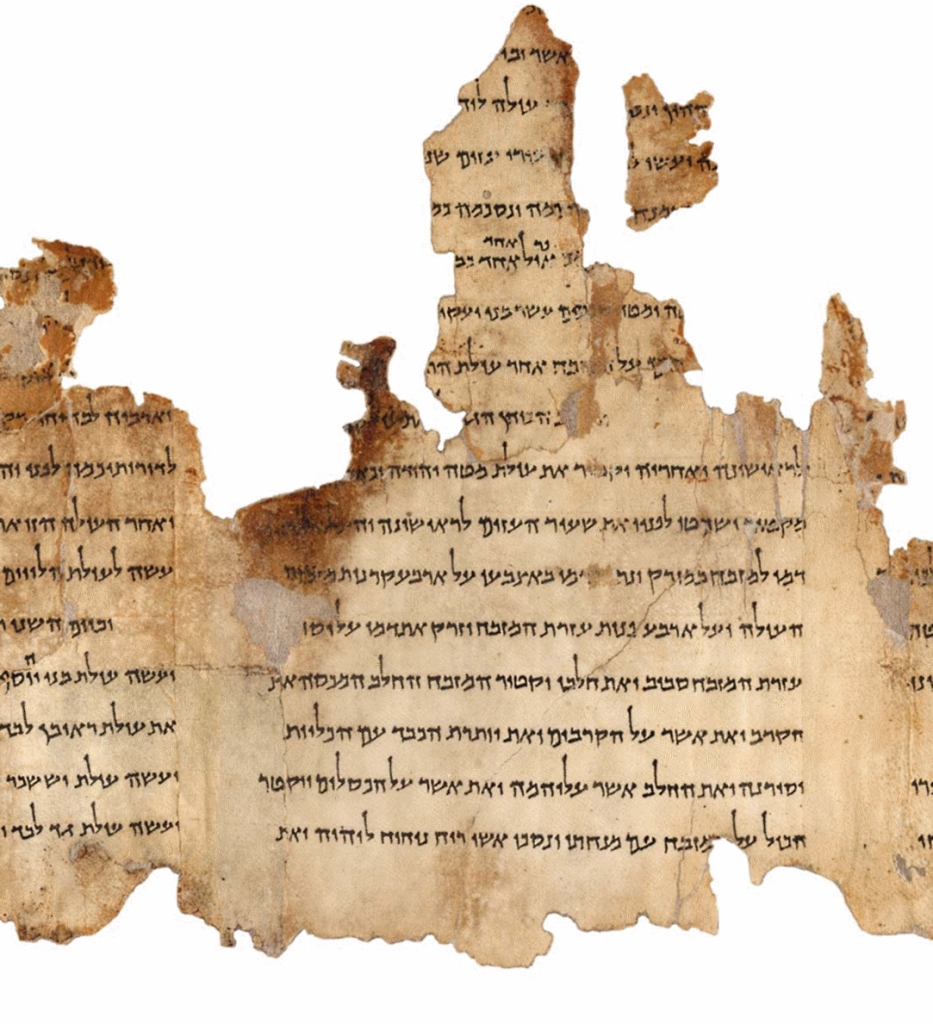
The handwriting of the principal surviving copy is usually placed around the turn of the era. Many specialists would put the composition’s development around the second century BC, during the Hasmonean period. That is an estimate about when this arrangement of temple and other laws emerged, and different sections may draw on material with histories of their own. The manuscripts help scholars compare those histories, since similar passages survive in pieces with different dates and readings. The copy date gives us an ancient point by which the work was already being read or transmitted. It leaves the larger questions of authorship and development open to investigation. Hebrew text edition and introduction to the dating and composition. Schiffman’s discussion of the work’s earlier sources.
People have also asked whether the work was written by the group associated with the settlement at Qumran, or whether it was brought into a collection that preserved works of diverse origins. A cave find locates a manuscript at the end of one stage of its history. Authors, copyists, and the people who saved a manuscript can belong to different settings. In this case the legal concerns and the existence of related scroll fragments help scholars ask sharper questions about the circles in which the work circulated. The surviving main roll gives us evidence of careful copying and preservation, and its original intended audience is still a matter of interpretation. Introduction to the Temple Scroll and its authorship discussion.
The Cave 11 connection also belongs to a larger archaeological history. Records and early photographs from the same cave show that some manuscripts were known to the dig team and the antiquities trade at different points. The first photograph or transcript of a roll is consequently a record of access as well as a record of text. The original handling of a manuscript is easier to reconstruct when accounts from excavators, dealers, and editors can be compared. Scholarly review of the discoveries in Cave 11 and their early photographs.
Why the temple has three courts
The sanctuary occupies the center of the plan. Moving outward, the scroll describes three nested courts and gives details about the gates, rooms, and people associated with them. The measurements in the writing are ancient prescriptions, which scholars can use to draw a reconstructed plan. The drawing belongs to the history of reading the document. Archaeologists would ask another set of questions if they encountered walls in the ground, including which courses were found, how one building phase related to another, and whether the distances between buildings matched. An architectural prescription is unusually useful evidence for what a writer valued in sacred space. Its plans have to be compared with independent evidence when we study the buildings that actually stood in Jerusalem. Schiffman’s reconstruction of the temple and its courts.
Numbers 2 brings another arrangement into view. It organizes Israel’s tribal camps around the tent of meeting. Schiffman sees continuity between that pattern and the courts in the Temple Scroll. In his reading, the sanctuary, the occupants closest to it, and the tribes farther out supply an ancient model for the building’s gradations. The comparison helps explain why the scroll can be so specific about architecture while giving great weight to purity and offerings. The physical distances are part of how the writers pictured life ordered around God’s presence. Read Numbers in its wilderness setting before comparing it with a Second Temple text imagining a sanctuary. The courts and the biblical wilderness camp.
The calendar fits this arrangement into a whole year. Leviticus 23 supplies a familiar biblical framework of appointed times. The ancient scroll includes additional occasions and details about offerings. Those instructions give worship a regular rhythm and help explain why a document about a building has so much to say about dates and decisions outside the sanctuary. Readers can start with the festival language they know and then identify what the scroll chooses to spell out, where it arranges the events differently, or where it supplies a feature of its own. That is a practical way to compare a later interpretation with the biblical materials it draws on. Calendar sections in the Hebrew Temple Scroll transcription. Schiffman’s study of the festival calendar and sacrifice.
The plan tells us where people would stand. The calendar tells us when they would gather. Together they show how much the temple mattered to the writers.
How the work reads the Torah
Near the start of the extant text are words parallel to Exodus 34:10–16, where the Lord speaks of a covenant with Israel. In other sections the scroll takes material familiar from Deuteronomy and often casts it as God addressing Moses directly. That shift affects the way the laws sound when read aloud. The writers used the voice and language of Scripture to present a coherent set of laws as they understood them. The result can be compared closely with the biblical texts, sometimes line by line. Those same differences give researchers a way to examine how laws already known from the Torah came to be arranged and interpreted in one ancient setting. Schiffman on the opening and the divine voice.
The rules for judges offer a more concrete example. Deuteronomy 16:18–20 commands the appointment of judges and warns against partiality and bribes. Column 51, lines 11–18 of 11Q19 reworks this material, drawing in ideas from other places in Deuteronomy. Jeffrey Stackert’s study shows how the scribal arrangement brings laws about judging and administering the people into a particular relationship. Elsewhere the scroll gives sustained attention to the king, a subject readers encounter in Deuteronomy 17:14–20. As a reader, start with the biblical passage and ask what pieces recur, what the ancient document adds or moves, and how the new arrangement changes its emphasis. Jeffrey Stackert’s comparison of the judicial passages.
What the parchment itself adds
The writing rests on an exceptionally thin and light-colored surface. A 2019 study led by Roman Schuetz and colleagues used X-ray and Raman methods to examine its layers. They found a collagen base and an inorganic surface layer containing sulfate salts. The researchers proposed that the upper layer was connected to a distinctive way of preparing the parchment for writing. That is evidence about making an object, reached through a different method from the comparison of handwriting or of biblical passages. Knowing what the writing surface contains also helps conservators understand how it may respond to humidity and how they can keep it stable while the words remain available for study. Schuetz and colleagues, The Temple Scroll: Reconstructing an Ancient Manufacturing Practice.
The photographs make another distinction visible. The main roll preserves a much longer stretch of writing than the fragmentary witness. Both permit some words to be read while leaving gaps an editor has to handle explicitly. A translation may look continuous where its editor has supplied a probable word from context or from another copy. A reader using a transcription can look for brackets before quoting the exact wording. A photograph, a scholarly reading of the Hebrew, and an English translation make different contributions. Using them together can turn a familiar summary of the Temple Scroll into a close study of the ancient evidence. Hebrew text and guide to restoration marks.
Read the scroll alongside Scripture
We receive the Bible as true and accurate. The Temple Scroll gives us a rare opportunity to listen to ancient Jewish people thinking seriously about the laws in the books of Moses and the nearness of God’s presence in the sanctuary. Christians come to Hebrews 9:11–15 with those concerns already in view. Hebrews proclaims that Christ entered the greater sanctuary as high priest and secured redemption through his own blood. Read that passage on its own terms and then return to what the Qumran document preserves. The scroll makes an ancient concern for holy space, priesthood, and offerings tangible. The New Testament gives the Christian confession of what God has done in Christ.
What to look for first
- Find the manuscript number. Use 11Q19 for the principal scroll and 11Q20 for the separate, more fragmentary copy.
- Read an identifiable passage. Compare Deuteronomy 16:18–20 with the treatment of judges in column 51 of the scroll.
- Keep the layers of evidence in view. Ancient writing, archaeological recovery, and modern conservation each help answer a different question about the object.
For the setting of the cave, continue to our guide to Qumran and its manuscript caves. The Great Isaiah Scroll supplies a complementary example from another cave, a manuscript of a biblical book preserved at great length. The Temple Scroll offers something else equally worth studying. A long, carefully made roll carried a vision of laws, worship, and life together. Its physical survival brings that ancient reading of Scripture and its history of copying into view.
Questions readers ask
Is the Temple Scroll a plan of the Jerusalem temple as it stood?
It sets out a detailed prescription for a sanctuary and its courts. Archaeological remains and ancient accounts supply separate evidence for the buildings that actually stood in Jerusalem.
Is 11Q20 a piece broken from 11Q19?
11Q20 is cataloged as a separate manuscript of the composition, preserving overlapping material.
Sources and further reading
- Israel Museum, Envisioning the Temple — Curatorial treatment of the scroll, its setting, and the exhibit devoted to its interpretation.
- Israel Museum, Digital Dead Sea Scrolls — Custodian’s portal to the principal scroll and its discovery history.
- Yigael Yadin, The Temple Scroll, 1967 — Yadin’s early account, followed by the scholarly edition published by the Israel Exploration Society.
- Lawrence H. Schiffman, The Theology of the Temple Scroll — Primary scholarly interpretation of the first-person presentation, calendar, and sacred space.
- Jeffrey Stackert, Before and After Scripture — Close reading of the Deuteronomic laws on judges in 11Q19.
- Roman Schuetz and colleagues, The Temple Scroll: Reconstructing an Ancient Manufacturing Practice — 2019 materials study of the layered parchment and its implications for conservation.
- Israel Antiquities Authority, Plate 567 — Primary catalog of an image plate with Cave 11 material including fragments of 11Q20.





