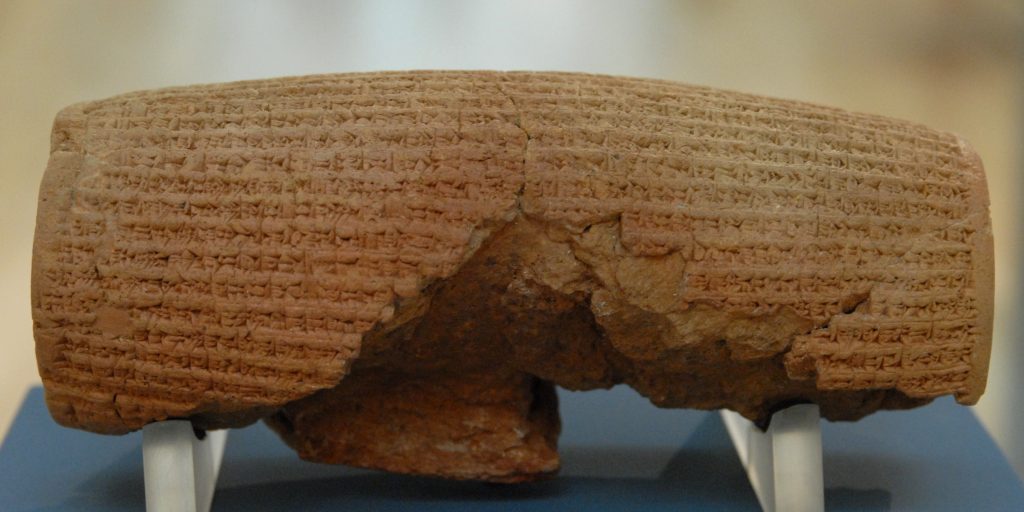
A clay cylinder found in Babylon carries the words of a Persian king who had just taken the city. Cyrus presents himself as a ruler who restored sanctuaries and returned displaced people to their dwellings. The book of Ezra opens in the same political world. It tells how Cyrus authorized a return to Jerusalem and the rebuilding of the temple there. The Cylinder names Babylon and sanctuaries in Mesopotamia and its vicinity. Ezra names Jerusalem, identifies the God of Israel and records provisions for His temple. Reading the two sources closely shows why the Cylinder is such a valuable find and why Ezra remains the source for the terms of the Jerusalem decree. Cylinder, lines 28–35
What you’ll learn
- Where the Cylinder was found and how later discoveries added to our knowledge of its text.
- What Cyrus claimed to restore after taking Babylon in 539 BC.
- How the inscription gives context to Ezra and Isaiah while speaking in the religious language of Babylon.
A new ruler in Babylon
In 539 BC the Persian army took Babylon, the capital from which Nebuchadnezzar II had once directed campaigns against Judah. The takeover put the city under a dynasty whose power had grown from the Persian heartland in what is now Iran. The Nabonidus Chronicle supplies part of the sequence. It records fighting at Opis, the taking of Sippar, the entry of Persian forces into Babylon without a battle inside the city, and Cyrus’s own later entry. The claim of a peaceful entry becomes clearer against that background. It says something specific about the taking of Babylon itself after a campaign that had already included fighting. Nabonidus Chronicle, col. iii, lines 12–22 · The Met, Achaemenid Persian Empire
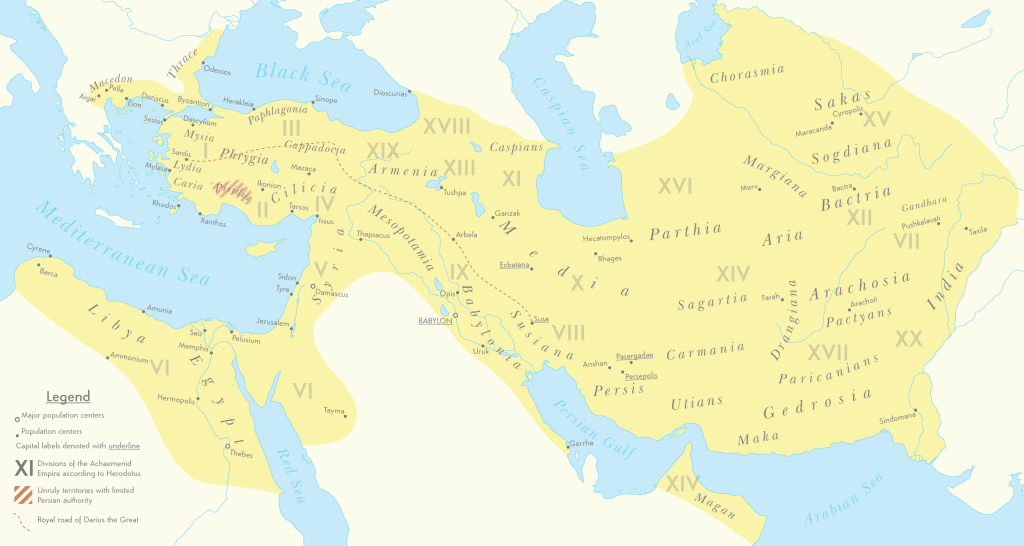
The old capital continued to matter after its capture. Its temples, experienced scribes and royal traditions gave a new ruler ways to present himself as the legitimate king of Babylon. The Cylinder uses Babylonian Akkadian in cuneiform, a script made by pressing signs into clay. A Persian monarch speaking in a local language was intelligible to the people responsible for preserving and interpreting Babylon’s traditions. His inscription borrows their ideas of the pious ruler who maintains sanctuaries, provides offerings and cares for the city’s defenses. The text also presents his own ancestry and uses expansive titles associated with Mesopotamian kingship. Those choices tell us how the regime wanted to be understood in Babylon. Cylinder, lines 17–35 and 37–45
What was found in 1879
The Cylinder was recovered at Babylon in 1879 by an expedition for the British Museum supervised by Hormuzd Rassam. A study of the discovery names Daoud Toma as the supervisor of the diggers who found it and notes uncertainty about the precise findspot among the ruins of Babylon. The shape fits a Mesopotamian tradition of commemorative inscriptions placed in the foundations of buildings or city walls. Toward the end the text describes work on Babylon’s defenses. This helps explain how an account of conquest and restoration came to be written on a curved object rather than on a flat administrative tablet. The Met, exhibition object notes · Michalowski, pp. 203–204
There are two different ways later scholarship filled out the record. One concerns this specific object. A small piece from the Yale Babylonian Collection, identified as part of the Cylinder in the early 1970s, preserved writing from the end of the text. The second concerns another object altogether. Two fragments held by the British Museum since the nineteenth century were recognized as pieces of a separate flat clay tablet inscribed with part of the same composition. Scholars could compare the overlapping wording. The fragments also show that a text found on a buried object could circulate in another physical form. We know of at least these two forms, while the size and audience of its original circulation remain open. The Met, Cylinder and tablet fragments · Discussion of BM 47134 and BM 47176
How Cyrus told the story
The beginning is damaged. In the sections that survive, the inscription accuses the previous king, Nabonidus, of neglecting correct religious practice and burdening the inhabitants of Babylon. It says Marduk looked for a ruler and chose Cyrus. The account of Cyrus’s entry is followed by his own presentation of his titles, ancestry and care for Babylon. The story was crafted to reassure Babylonian readers that their sanctuaries and rites mattered under a foreign king. Its charges against the old regime are the claims of a text issued under the new one. That makes them evidence for the public case Cyrus offered for his own rule. Cylinder, lines 4–28
The passage most often compared with Ezra comes near the end. It names places including Ashur, Susa and sanctuaries across the Tigris. Cyrus says he returned divine images to their shrines and gathered the inhabitants back to their dwellings. He also says he resettled gods whom Nabonidus had brought into Babylon. In Babylonian terms the cult image belonged in the sanctuary and participated in its worship. Returning it could involve restoring offerings and the people who carried on the rites. The inscription asks the restored gods to intercede for Cyrus and his son Cambyses. That request ties the act of restoration to the well-being and durability of the new dynasty. Cylinder, lines 28–36
The Cylinder lets us hear how Cyrus addressed Babylon. Ezra lets us follow what his authorization meant for worship in Jerusalem.
What Ezra says happened in Judah
Ezra 1 takes us to the first year of Cyrus and recounts a proclamation for the temple in Jerusalem. People belonging to God’s people could go up to rebuild it. The surrounding community was to help with resources, and Cyrus handed back temple vessels Nebuchadnezzar had taken from Jerusalem. In Ezra 6, during the reign of Darius, a search turns up a memorandum in the fortress of Ecbatana in Media. This later passage preserves details about rebuilding, royal expenses and the return of vessels. The chapters give us a proclamation addressed to people who could make the journey and a record relevant to officials investigating who authorized the work. Joachimsen, discussion of Ezra 5–6
- Who issued it? Both the Babylonian inscription and the decree in Ezra come from the time of Cyrus, the Persian king who took Babylon.
- What was restored? The Cylinder describes regional sanctuaries, cult images and residents. Ezra describes the Jerusalem temple, its vessels and a returning community.
- Where can I read each claim? Read Cylinder lines 28–35 for the regional restorations, Ezra 1 for the proclamation and Ezra 6:1–5 for the memorandum.
There is a meaningful difference between what each text says was carried back. The Cylinder presents the return of images of Babylonian and neighboring gods. Ezra explicitly describes gold and silver vessels for worship in Jerusalem. In the biblical tradition the God of Israel had forbidden making a divine image for worship, so the restoration of His temple has a different form. The similarity lies in the political possibility of a ruler sanctioning local restoration. The place, contents and religious meaning of the Jerusalem decree come from Ezra. The Cylinder does not name Judah, Jerusalem or the exiled Judeans. Cylinder, lines 30–35
Permission was the beginning of a project that faced local resistance and took years. Read Ezra 3 for the rebuilding of the altar and the laying of foundations, Ezra 4 for opposition and Ezra 5–6 for the resumption and completion of the work under Darius. Haggai 1 also portrays the people having to decide how to order their own lives as rebuilding resumed. Ezra dates the completion to the sixth year of Darius, conventionally around 515 BC. The turn in imperial policy gave the community an opportunity. It still had to undertake the return, cultivate life in the land and carry out the work of rebuilding. Joachimsen, history and narrative of the rebuilding
Ezra’s first year is best read in the context of Cyrus’s new rule over Babylon. He had already led major campaigns and ruled in Persia before 539 BC. What changed for the Judean exiles was the ruler who could authorize movement out of Babylonia and restoration in Judah. A change like that can reach different households in different ways. Cuneiform records associated with Al-Yahudu continue to show Judeans in Babylonia long after the Persian conquest. Ezra also portrays a company preparing to leave and neighbors supplying aid. Permission to return created a choice with costs and possibilities, and those who stayed belong to the history of the diaspora. Alstola, ch. 4, on Judean communities in Babylonia
Why people call it a charter
In 1971 Iran presented the United Nations with a replica of the Cylinder. Its modern reception as an early expression of human rights reflects the importance people have attached to the idea of a conqueror restoring displaced communities and sanctuaries. The inscription itself is a monarch’s account of chosen acts and favors. It describes tribute, divine authorization and the duties of a king of Babylon. Its form and vocabulary give us grounds for reading it within ancient royal conventions. Awareness of that setting makes the restoration passage more interesting, because we can ask what restoration did for those communities and what it accomplished for the new ruler. UN record of the 1971 gift · Amélie Kuhrt, ‘The Cyrus Cylinder and Achaemenid Imperial Policy’
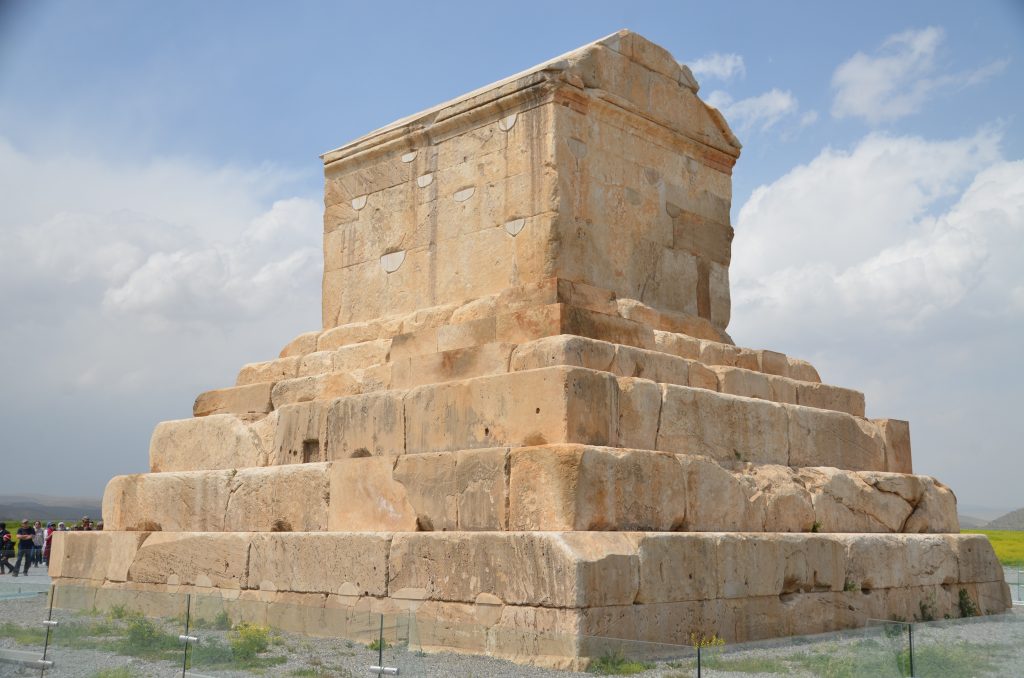
The British Museum’s short film on the Cylinder lets you see its surface and hear how the message has been understood in later centuries. Listen for the distinction between the act of restoring communities and the authority Cyrus claims for himself in the inscription. Then compare the wording of the restoration passage with Ezra 1. Watch ‘A new beginning for the Middle East’.
Cyrus in Isaiah and the Christian reading
Isaiah 44:24–45:8 speaks of Cyrus in the context of the Lord’s promise to restore Jerusalem. It calls him God’s shepherd and describes the Lord calling him by name and enabling his mission even though Cyrus does not know Him. Second Chronicles 36:22–23 and Ezra 1:1–4 describe the Lord stirring Cyrus to issue the proclamation. We read these claims as true. Scripture gives an account of God’s action in public history, involving a ruler whose own Babylonian inscription credits Marduk. From a Christian perspective it is striking that the Bible grounds hope in what God promised to His people and can portray an outside ruler as the means of keeping that promise.
The clay record helps us imagine the political setting in which the exiles heard good news. Babylon was still an imperial capital. The people who came home would travel to a city whose temple lay in ruins and would still live under a foreign king. Yet a change in who governed Babylon meant that families could go home, take back objects once carried away in conquest and start worship together in Jerusalem. Compare this scene with the Chronicle’s record of Jerusalem’s capture and Jehoiachin’s household in exile. The Cylinder belongs at the point where the historical story begins to move toward rebuilding.
Sources and further reading
- British Museum, Cyrus Cylinder 90920 — Accession record for the cylinder and its surviving sections.
- The Metropolitan Museum of Art, The Cyrus Cylinder and Ancient Persia — Discovery, form, fragment history and associated tablet fragments.
- Cyrus Cylinder translation — Line-numbered translation based on Cogan and adapted to Schaudig’s edition. See 28–35 for restoration and 37–45 for building works.
- Nabonidus Chronicle — Column iii gives the reports of Opis and the Persian entry into Babylon.
- Extraction & Control, Institute for the Study of Ancient Cultures — Piotr Michalowski, ‘Biography of a Sentence: Assurbanipal, Nabonidus, and Cyrus,’ pp. 203–204, on the 1879 recovery and recognition of separate tablet witnesses.
- Kristin Joachimsen, ‘Yehudite Imaginations of King Darius and His Officials’ — Ezra’s presentation of Persian administrative support and the temple’s completion under Darius.
- UNESCO, Pasargadae — Archaeological setting of Cyrus’s Persian capital and tomb.
- United Nations, Replica of ‘Edict of Cyrus’ — The modern reception of the Cylinder and Iran’s gift in 1971.





