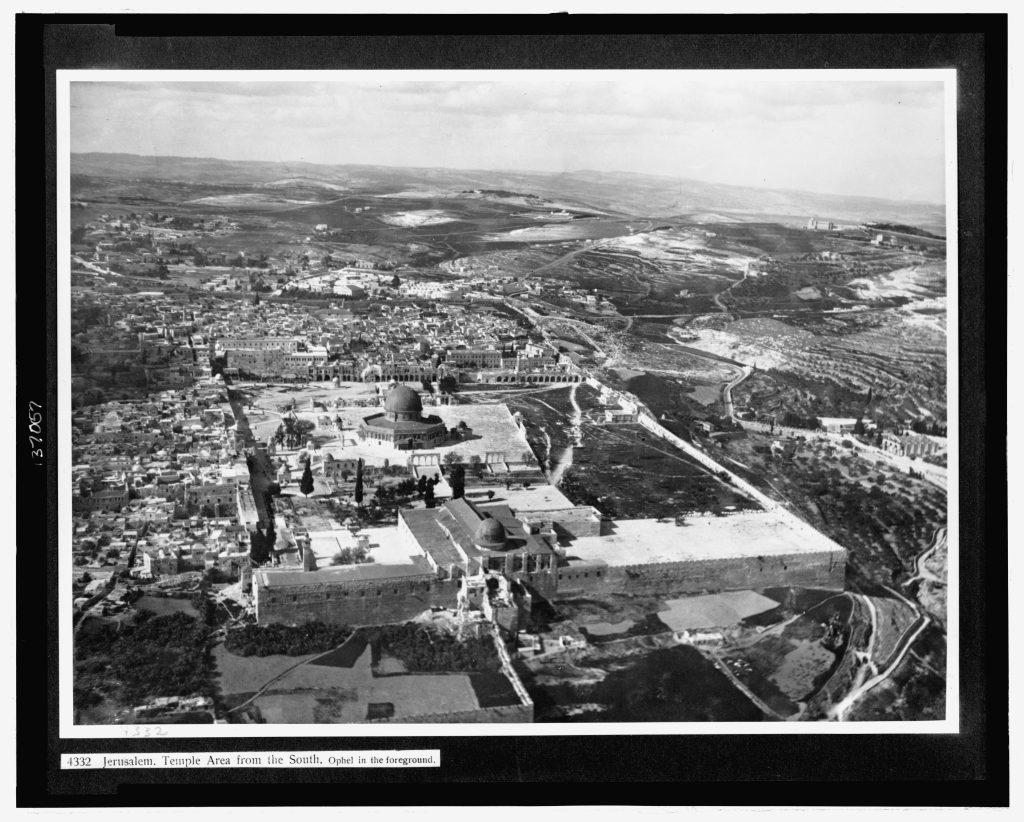
The name of a king of Judah survives on a lump of clay small enough to disappear in a handful of soil. On one side are a Hebrew name and royal title around a winged design. On the other, small marks preserve the shape of a material and cords that have disappeared. The impression attributed to Hezekiah was recovered from material excavated on Jerusalem’s Ophel. The king is familiar from the Bible. The little object offers an unusual way to approach him, through the physical practices of an office that sent, received and secured written documents.
What you’ll learn
- What a clay seal impression records when the seal and document themselves have disappeared.
- What the excavated context adds to the identification of Hezekiah.
- How to interpret the royal symbols alongside the biblical account of the king.
The site name also matters for following the find through its modern history. The team that sorts the soil can work at a separate installation from the team that dug it. A reference to the Temple Mount Sifting Project tells us who helped recover the bulla, while the Ophel excavation report supplies the place and context of the original deposit. The report identifies a locus, a recorded context in the excavation, and a register number for the individual object. A person who wants to compare the claim with other finds can use both identifiers to follow the evidence.
From an excavation layer to a wet-sifting tray
The Ophel lies on elevated ground immediately south of Jerusalem’s Temple Mount. Eilat Mazar’s excavations documented remains of different periods on that part of the ridge. Earth removed in a controlled excavation can hold material too small to see while a wall or deposit is being cleared. The team recorded the area and excavation locus, and samples of excavated soil were taken for wet sifting. Recovering the little clay impression during that stage is a useful reminder that digging is only one part of finding something. Site records keep an object’s connection to a place intelligible after it has been separated from the surrounding earth. Ophel excavation report, volume II.
The report places the object in Area A from the 2009 campaign and records it as register number 3855. The finding and its announcement in 2015 belong to different moments in modern research. Wet sifting involves working soil through screens with water so that smaller objects can be sorted. The method brought the tiny object to notice, and its arrival in the tray can still be traced back to the excavation. It came from excavated Ophel material processed with the aid of the sifting project. That history is valuable in its own right. It gives the object a narrower geographical and archaeological context than the phrase “found in Jerusalem” would convey by itself. The sifting team’s account of the find.
A good findspot supplies some answers while leaving others open. The excavation recorded the deposit containing the object. That gives a researcher something concrete to compare with other finds and levels. It leaves room for a different question about the object’s earlier movements. Where was the clay first applied? Which room was the document in when the impression broke away or was discarded? A piece of clay can end up in fill or refuse after use. It has a place of application, a place of ancient deposition and a place of modern recovery. Those places do not have to be identical for the recorded context to be valuable.
Read a bulla from both sides
The seal and the impression it leaves are separate things. A carved seal can be pressed into soft clay many times. A lump of clay carrying the impression is called a bulla. The excavated bulla is principally evidence for the act of applying the seal. The report describes traces of a papyrus document and several cord grooves on the reverse. Looking across both surfaces helps us reconstruct the operation. A document could be rolled and tied, and the seal could mark the clay that held the arrangement together. Breaking it to open the document could leave a small object with a recognizable front and reverse, even after the document and binding material were lost. Mazar and colleagues’ report, no. B1.
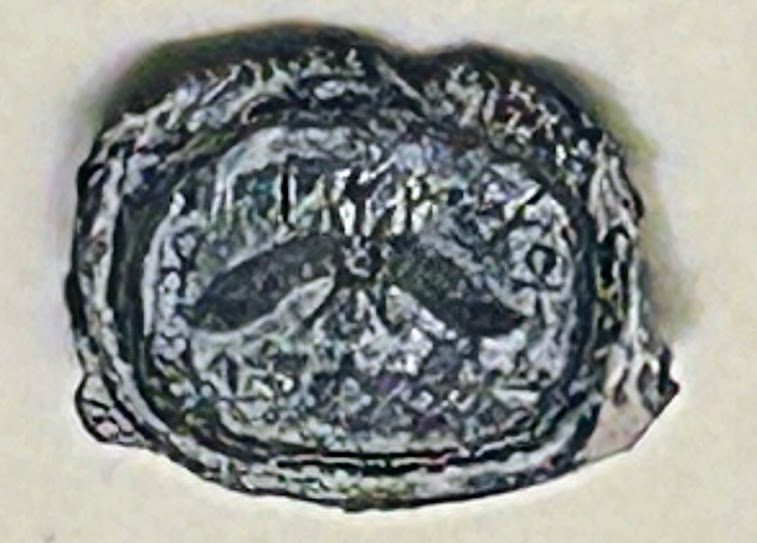
In the report’s reading, the letters name Hezekiah and Ahaz and give the title king of Judah. English descriptions often expand the relationship as Hezekiah, son of Ahaz. The relationship is supplied in the translation of the ancient name and title formula. Individual letters are less distinct where the clay or impression is uneven, so an edition explains what survives and where it reconstructs a form. The identification relies on a combination that is strong in this context, including the royal title, the reading of the names and the securely recorded place of recovery. The same care that allows a missing stroke to be recognized avoids treating every mark as equally legible. The field report’s transcription and explanation of the surviving strokes.
The existence of a royal stamp implies that the name and office could be recognized on sealed material. It gives no requirement that the king himself pressed this example. A seal or its impression could be used by someone entrusted to act with delegated authority. It can tell us what designation the issuing authority used and what kind of physical security the document had. The back rarely receives the attention given to the royal name, but it answers some of the most interesting questions here. It tells us what the clay was pressed against.
The king’s title survived on the front. On the back, the grooves and fibers preserve something of the work of sending a document.
A personal name by itself would give a much weaker identification. The excavation authors note an ancient ostracon from Jerusalem that includes a form of the name Hezekiah and evidently refers to another person. The bulla brings the name together with Ahaz and the title of a kingdom, a much narrower combination. This distinction helps when two objects in a museum are labeled with the same familiar name. Ask whether the letters identify an office, whether a patronymic or a place is present, and how independently the findspot and date can be assessed. The report’s discussion of the name in other inscriptions.
Winged designs in Judah and its neighbors
At the center of the excavated impression is a winged sun disc, flanked by signs of the Egyptian type known as ankhs. Earlier discoveries and examples from collections provide comparanda for Judahite use of winged emblems. Ancient craftspeople and patrons used motifs that traveled across political boundaries. An image might acquire a particular role when used by a new patron. The report interprets the disc as a symbol of divine protection and discusses the possibility of a change in Hezekiah’s emblems over time. Such a reconstruction depends on identifying and ordering a number of different impressions. The excavated bulla establishes the design present on this example. Discussion of the symbols and of seals from collections.
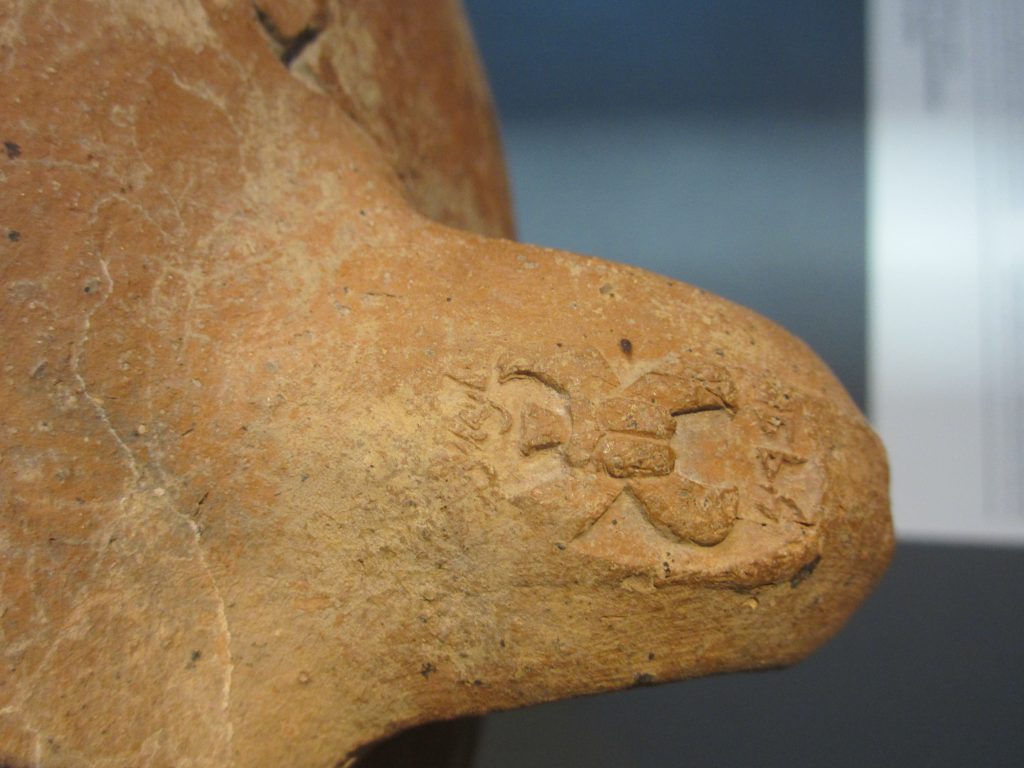
The jar handle illustrates why a familiar motif does not make two objects interchangeable. A maker could stamp a handle where a mark would remain with a storage vessel. The Judahite marks often read as belonging to the king illustrate administrative labeling on pottery. The excavated bulla did a different job. Its relationship to papyrus and cords suits a sealed document. We can compare the two kinds of mark to ask how royal administration made its identity visible on different materials. The kind of vessel or document involved must still be worked out from each individual object and its context.
- Look at the shapes and writing on the stamped face.
- Ask what the reverse reveals about the material that once touched it.
- Check the excavation record before comparing it with examples that entered collections without a recorded findspot.
The excavation authors have suggested a connection between the use of the ankh signs and the episode of illness and recovery in Isaiah 38–39. It is an interpretation of the design. The clay contains a symbol of life and a royal name without a written account of an illness. The dates of different impressions and the distribution of related designs have to bear their own weight in a historical argument about what prompted someone to choose the emblem. Readers can keep the suggestion in view and give the inscription its clearest evidential role, as an object carrying the king’s name, title and chosen image.
Read the royal name beside 2 Kings
Second Kings records that Hezekiah succeeded his father Ahaz as king of Judah and gives sustained attention to his reign. The designation on the bulla makes that combination of names and office especially arresting. The geographical connection makes it more valuable than an isolated text without a find record. In other articles, we can trace Hezekiah abroad through Sennacherib’s annals and at Jerusalem through the waterworks and their inscription. The seal impression belongs to a different kind of evidence again. It places the name in the physical practices of Judah’s own administration. The biblical accounts of Hezekiah in 2 Kings 18–20.
In 2 Kings 19 Hezekiah receives a letter and carries it into the temple to pray. Archaeology brings the material world of letters and communications closer, though the object from Area A gives no original document or sender to compare with that particular episode. It is possible to picture a folded or rolled document carried from hand to hand, opened and read. The Biblical account describes what Hezekiah did when he read the threats against Judah. He spread the letter before the Lord and appealed to God, knowing the power of the king who had sent it.
As Christians, we trust that account and appreciate the tiny artifact as its own piece of evidence. Its survival lets us attend to a feature of government that biblical narrative often mentions in very few words. Names, messages, documents and promises had weight because actual people wrote them and relied on them. What remains of this one process is smaller than a coin. The court named a king, someone pressed clay onto a document, and the site eventually received that clay among its remains. The marks on the two sides are enough to make both the office and the daily work around it more real.
Sources and further reading
- Eilat Mazar and colleagues, Hebrew Seal Impressions from the Ophel, Area A2009 — Register no. 3855 and catalogue B1. Transcription, reverse side, symbols and comparanda.
- The Ophel Excavations to the South of the Temple Mount, Final Reports, volume II — Excavation publication and framework for the objects from the Ophel.
- Temple Mount Sifting Project, Seal Impression of King Hezekiah — Announcement, sifting circumstances and image of the excavated impression.
- 2 Kings 18–20 — Family and royal history of Hezekiah, the Assyrian crisis, prayer and recovery.





