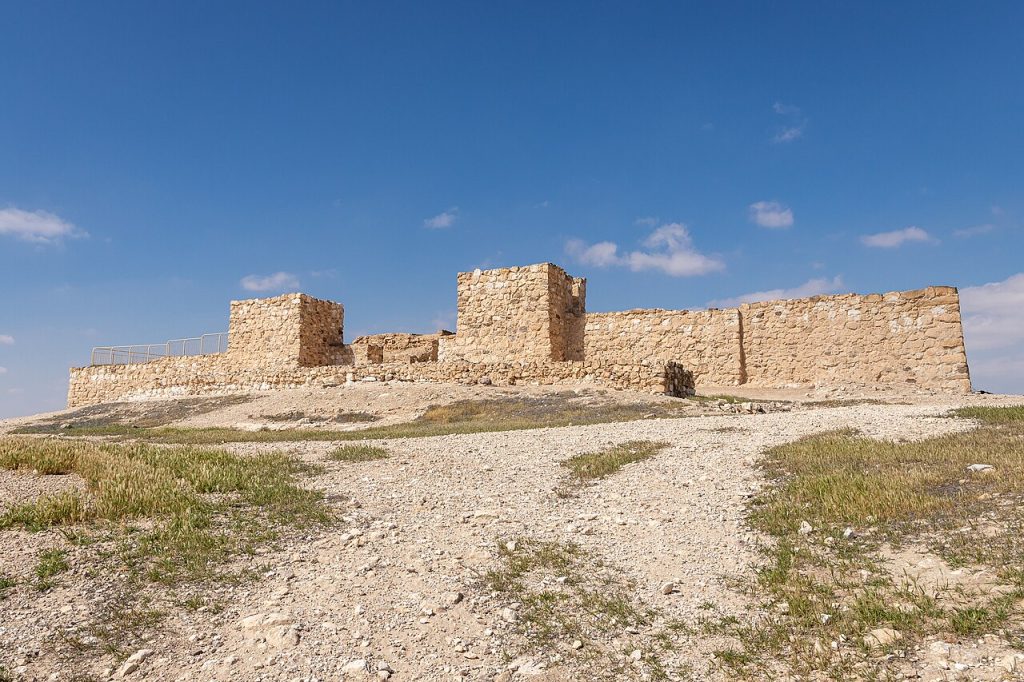
Someone at the Judahite fort of Arad needed to know how much wine to issue. The instructions came in a short Hebrew letter written in ink on a broken piece of pottery. The addressee was Eliashib, who appears by name in a group of texts concerned with keeping the garrison supplied. A different letter warns about Edom and orders men to another position. These are the ordinary documents of people trying to hold Judah’s southern frontier around 600 BC, in the last years of the kingdom. The Bible tells what happened to Judah’s kings and capital. The letters show what it took to keep men posted in the south while that kingdom still stood. Arad ostracon 1 · Arad ostracon 24
Key takeaways
- Yohanan Aharoni’s excavations from 1962 to 1967 uncovered Hebrew ostraca from a Judahite fortress in the northern Negev.
- The texts record supplies, troop movements, personnel, and correspondence, much of it around 600 BC. Some letters were addressed to a man called Eliashib.
- Multispectral imaging helped researchers read the reverse of one letter, and handwriting analysis suggests that several people could write within the military network.
The fort and the writing that survived
Tel Arad has remains from more than one period. The main group of late Judahite letters came from the upper mound, where excavators distinguished successive forts and changes over centuries. The earliest city on the site was older by well over a thousand years. Later forts also occupied the mound. Aharoni’s team cataloged walls, floors, pottery, and the contexts in which the texts turned up. That work allows us to connect a particular group of potsherds to a fort of Judah, while keeping the building phases and texts distinct. The letters commonly studied for the last days of Judah belong to the late Iron Age. Excavation history and sequence
An ostracon is a sherd from a ceramic vessel that was used as a writing surface. Its plural is ostraca. A fragment already broken off a jar had the advantage of being easy to find and sturdy enough to carry. The ink on it could wear away while the pottery survived. That helps explain why some of the letters look more like stains than handwriting in an ordinary photograph. We get a better sense of the ancient choices by looking across the corpus. Some sherds are narrow or curved, and others offer a broad surface. Writing to suit each available piece was part of making an everyday note. Arad ostraca and their physical condition
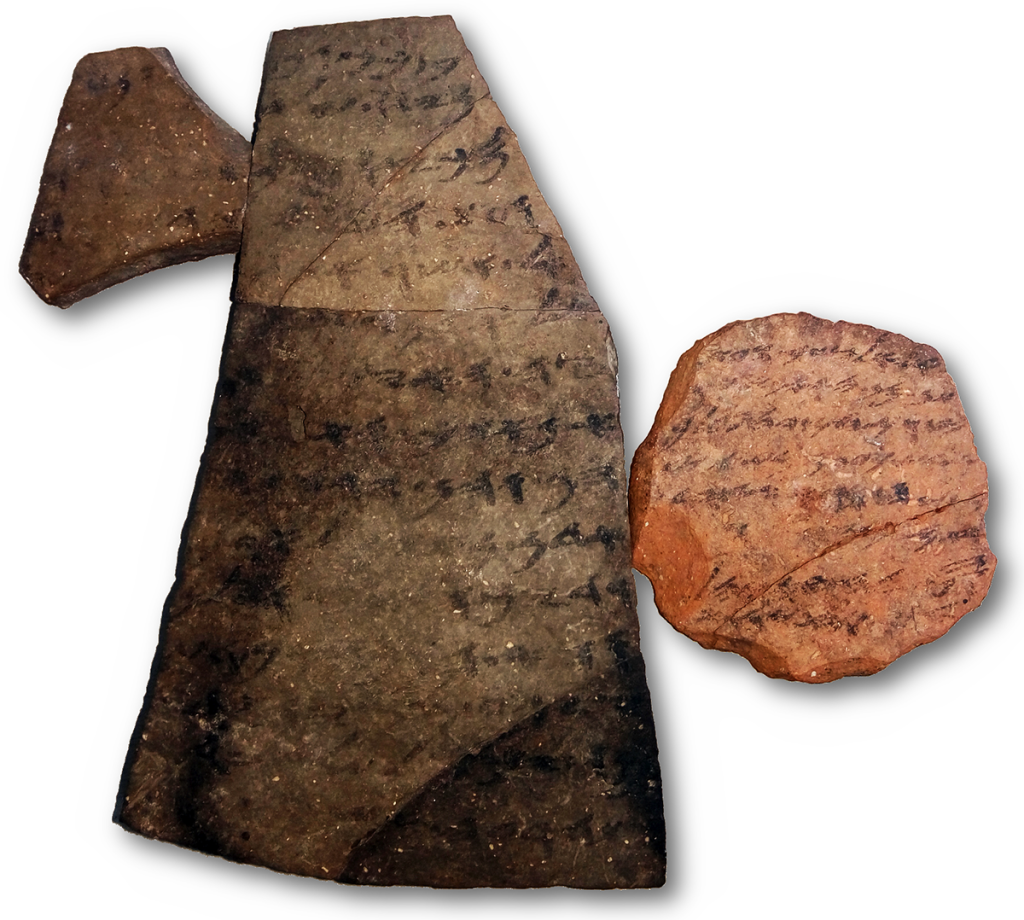
What survived is also a selection from a much larger stream of communication. Important correspondence could be written on materials more vulnerable to decay. A supply note on a sherd could be discarded when it had done its work. Archaeologists therefore ask where a text lay and what other material surrounded it. A cluster of correspondence associated with one addressee can come from a working archive. Part of a fort’s correspondence can also be scattered, reused, or lost. The value of Arad’s record lies in the number of letters and related texts we can compare rather than in an expectation that the collection preserves every kind of order. Catalog of Aharoni’s published corpus
What the quartermaster was asked to do
Arad 1 opens by addressing Eliashib and then issues an order about wine for the Kittiyim. The short list has the feel of work that people did routinely. Other letters refer to flour and oil as well. Researchers infer from these records that Eliashib worked as a quartermaster or supply officer for the fort. Kittiyim is the name the texts use for a group receiving supplies. Nadav Na’aman interprets the group as hired troops operating in the Negev, probably drawn from the wider eastern Mediterranean world. The detailed origin and composition of the group remain questions for historians. A person working at Arad mainly had to know where its provisions should go. Arad 1, transliteration and translation · Na’aman’s study of the Eliashib archive
Other records take us beyond a single dispatch from an office. Someone had to bring grain or wine to a store, account for the quantities, and keep enough to meet further requests. Instructions could come from people who had many forts and routes to consider. A person receiving and reading an order at one place needed to know which unit or person could actually carry it out. These details are reasons to distinguish military logistics from battle narratives. Even a letter that names no combat can tell us something about the shape of a kingdom’s defense, because it reveals repeated movement of goods and messages between people with specific duties. The garrison’s administration in the Arad corpus
Arad 24 has a different urgency. The damaged letter orders men to Ramat-Negeb and urges that their arrival be secured. The writer closes with the danger posed by Edom. The names of places and officials are valuable even when some lines have gaps. For an officer in Judah a place name could mean a distance people had to cross and a position they could be called upon to defend. It would go farther than the sherd allows to assign it to the day of a particular battle or to a specific sender named in Scripture. What the letter does show is Judah’s concern about the security of towns at its southern edge. Arad 24, the order mentioning Edom
A city could fall in a matter of days. The letters from Arad show the work of keeping a kingdom supplied and guarded over years.
A letter with writing on the other side
For decades after the excavation, the visible writing on the front of Arad 16 was the basis for reading the letter. In a modern study, researchers took photographs at different wavelengths to find which images best distinguished ink from the clay. The shots made parts of the front easier to read. They also revealed writing on the reverse that was practically invisible in an ordinary color photograph. A writer who had run out of room on the front had continued on the other side. The researchers read an additional request for wine and indications of more dealings between people in the same administrative circle. The multispectral study of Arad 16
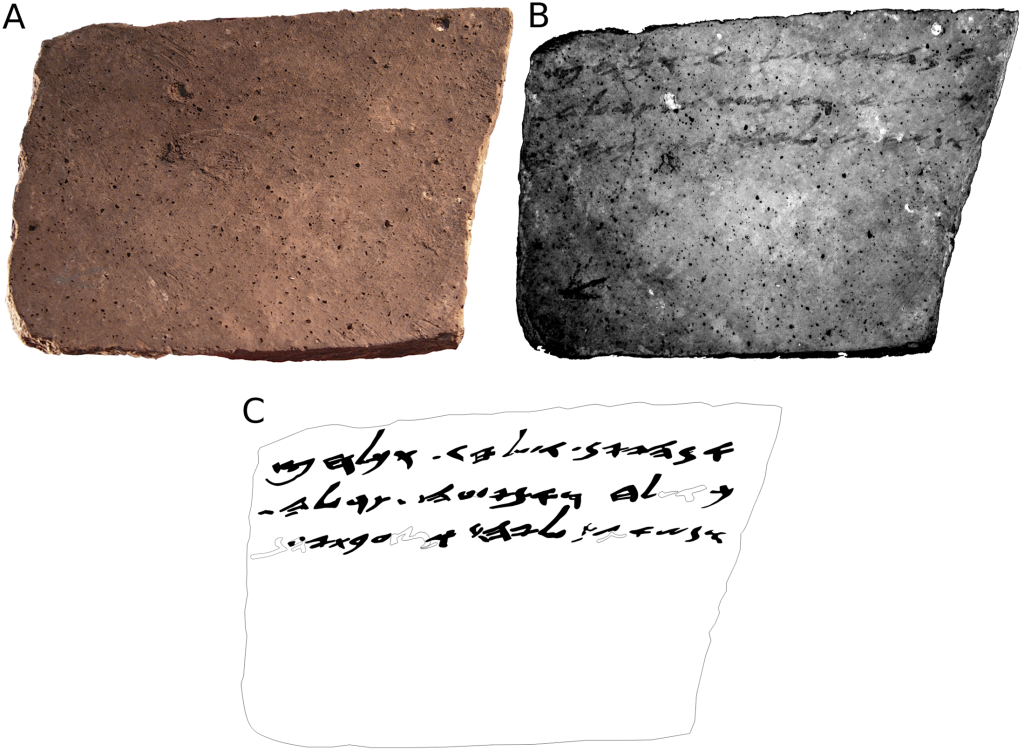
The three views of the reverse are useful for different reasons. The first shows what can be seen under ordinary photographic conditions. The second helps distinguish some of the ancient marks from darker parts of the ceramic surface. The third records the researchers’ reading and their reconstruction of some uncertain strokes. Those are different kinds of evidence. A new photograph may give a better basis for making out a line, but an editor still has to decide which marks belong to the letter, where a word begins, and what can be supplied. In a very short document, a single better-read letter can affect the translation of a whole phrase. Images and drawing of Arad 16, reverse
What the handwriting can tell us
A 2020 study examined 18 written texts on 16 Arad sherds. The researchers compared recurring letter forms by algorithm and by forensic document examination. The forensic analysis found a high probability of at least twelve writers among the texts studied, more than the lower estimates produced by earlier comparisons. Several letters had been sent to Arad from elsewhere. The study treated the number as evidence for literacy across parts of the Judahite military network, with some writing likely done at the fort itself. From this small set of correspondence we can see writing in use for ordinary administration. A count of the readers and writers of all Judah would require much broader evidence. Shaus and colleagues on the sample and results
A good way to understand the work is to ask three questions in sequence.
- Whose hand wrote this text? Compare repeated letters and their strokes across texts.
- Where might it have been written? A letter can reach the fort from another place. An internal list is a different kind of evidence.
- Who could act on what it said? A text addressed to a particular official belongs in a network of people who could use it.
Judah’s frontier and Jerusalem’s fall
Second Kings 24 and 25 follow the upheaval at the capital, from the earlier deportation under Jehoiachin to the siege and destruction under Zedekiah. Jeremiah 37 and 39 record the uncertainty of the final siege and the breach of the city. A person reading Arad 1 or 24 enters that broader era at a distance from Jerusalem. The dispatches give us the perspective of people managing provisions and frontier dangers while the kingdom still had officers and garrisons. We can read the Lachish letters in a similar way, while attending to each archive and its own locations and precise dates. The biblical accounts of Judah’s last years
Jeremiah 36 describes a different kind of writing from the same period. The prophet dictates words to Baruch, who writes them on a scroll, and officials hear those words read aloud. One scene involves a prophet, a scribe, and officials, while an order from Arad concerns the issue of supplies or the movement of men. Together they help us see that a written text could have a life beyond the hands of the person who made its letters. The evidence of writing in a military network illuminates the skills on which one part of Judah depended. It does not date Jeremiah’s scroll or identify the person who compiled a biblical book. Jeremiah 36
Scripture uses these events to tell us something about more than the size of Babylon’s army. It remembers what Judah had been told, what its rulers chose to trust, and how the people experienced the consequences. As Christians, we trust that history and the Lord’s word that came to people living through it. The people who wrote these short letters had immediate obligations they could not set aside. They could send provisions or order troops to another station. Such practical decisions give us a picture of life in the old kingdom and make it easier to hear the prophetic warnings as words about the real world those people inhabited.
If we ask the ostraca to do the work of a court chronicle, the scraps may seem too small. They are large enough to preserve an order, a name, a request for wine, and an officer’s anxiety about another station. At Arad, these bits of ink survived from people who had little reason to expect anyone outside their circle to read them. Their care over provisions and personnel takes us into the workings of the kingdom from below. Holy Scripture gives us Judah’s history from within the covenant. The finds let us see some of the ordinary responsibilities of those who lived in it.
Sources and further reading
- The Fortress Mound at Tel Arad, Shelby White and Leon Levy Program — The project and excavation sequence of the forts on the upper mound.
- Yohanan Aharoni, Arad Inscriptions — Catalog record for the 1981 English edition of the primary excavation corpus.
- Nadav Na’aman, Textual and Historical Notes on the Eliashib Archive from Arad — Research on the addressee, the Kittiyim, and the Edomite threat in the late Judahite Negev.
- Digital Edition of Ancient Palestinian Scripts, Arad 24 — Object record, transcription, and translation of the military order about Ramat-Negeb and Edom.
- Digital Edition of Ancient Palestinian Scripts, Arad 1 — Object record, transcription, and translation of a supply order addressed to Eliashib.
- Shira Faigenbaum-Golovin et al., Multispectral imaging reveals biblical-period inscription — Research article and photographs showing the renewed reading of Arad 16.
- Arie Shaus et al., Forensic document examination and algorithmic handwriting analysis — Analysis of 16 potsherds carrying 18 texts, with figures and published permissions for the images.
- 2 Kings 25 and Jeremiah 39 — Biblical accounts of the siege and fall of Judah’s capital.



