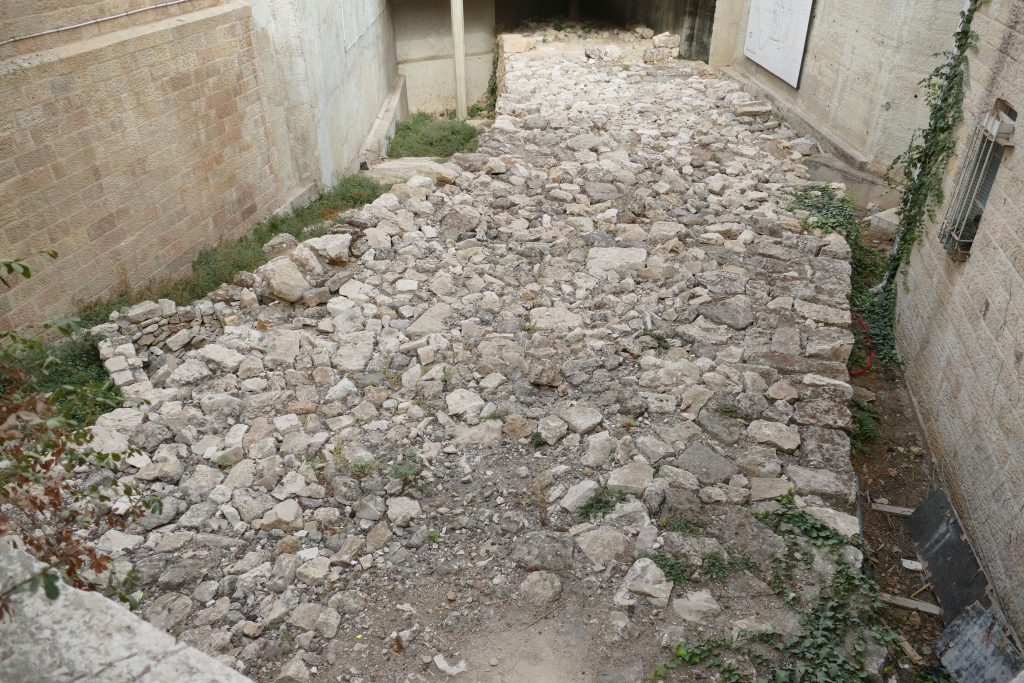
Below street level in Jerusalem’s Jewish Quarter, a bend in a band of stone marks the line of an ancient city wall. It is about seven meters wide, roughly the length of a small room laid sideways. Look closely at the excavation and there is a quieter feature with as much history in it. Parts of buildings already stood where the city put up this defense. The wall was built across them. That relationship between masonry and homes is one of the reasons scholars have read the site alongside biblical accounts of Jerusalem preparing for a siege. Location, dimensions and excavated houses at the Broad Wall.
We believe the Bible is true and accurate. When Chronicles describes Hezekiah strengthening the walls and adding another line of defense, a place like this helps us imagine what those preparations could mean for the people who lived nearby. Isaiah also describes Jerusalem’s houses being pulled down to strengthen a wall. Archaeologists can put the wall and the houses into order, and they can give reasons for dating the work. The name of the king who commissioned this particular stretch is a further question. The foundations give us a good place to learn why scholars approach those questions in different ways.
What you’ll learn
- What the Broad Wall’s foundations reveal about Jerusalem’s growth onto the Western Hill.
- Why many scholars connect it with Hezekiah and how another late eighth-century setting has been proposed.
- How Isaiah and Chronicles use the city’s preparations to ask different things of their readers.
Find the wall in the modern city
Jerusalem’s ancient settlement spread beyond the narrow southeastern ridge often called the City of David. Across the valley to its west lay the higher, broader terrain archaeologists call the Western Hill. The revealed wall occupies part of that hill in today’s Jewish Quarter. The modern street lets a visitor look down onto a level much older than the houses nearby. Locating it in the expanding city is the first step in understanding it. An outer line of defense could bring settled areas inside a fortified perimeter, and in the process it could pass through houses already standing there. Israel Antiquities Authority on occupation and fortification of the Western Hill.
Under the direction of Nahman Avigad, archaeological work in the Jewish Quarter began in 1969 and continued into the early 1980s. The Broad Wall was uncovered in the early part of those excavations. Avigad’s team recorded fortifications, other buildings and remains from later use of the same area. The excavations were divided into areas so that their relationships could be studied and reported separately. The section called the Broad Wall belongs to Area A. The formal report allows researchers to compare it with fortifications in other areas and with the remains it crosses. Jewish Quarter Excavations, volume I, edited by Hillel Geva.
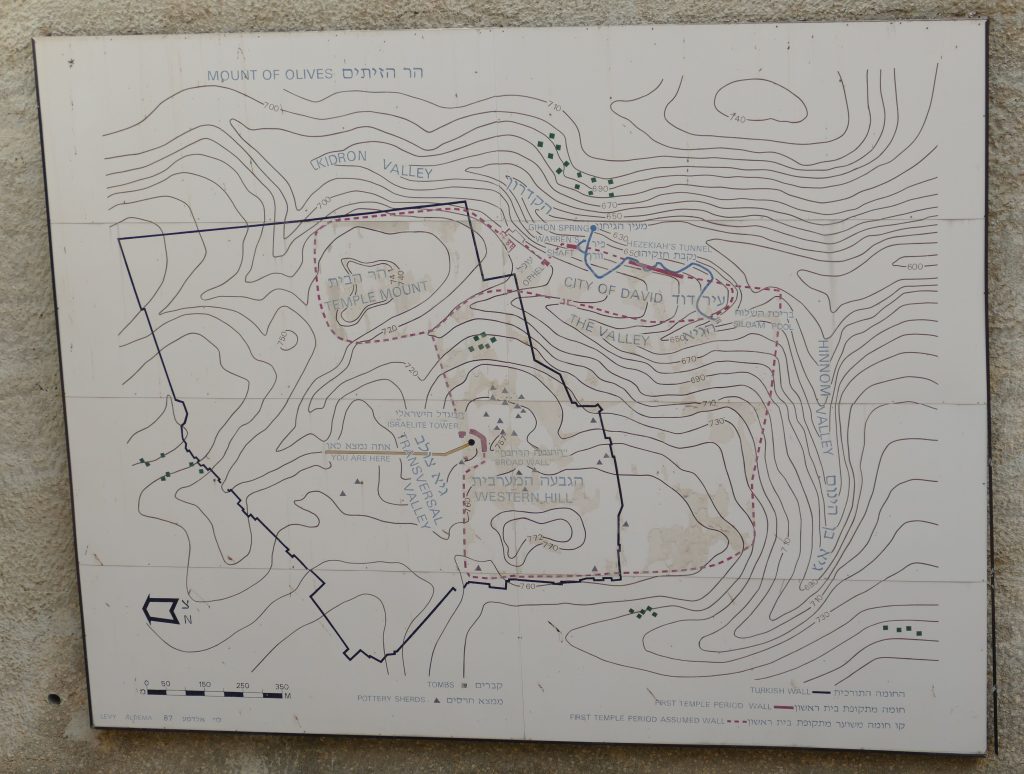
The excavated line extends for about sixty-five meters. Its upper courses and towers, if present along the original extent, have a different preservation history from the exposed foundations. From the width we can appreciate the amount of masonry concentrated in an open trench of the modern neighborhood. The visible stretch also turns, a reminder that people were adapting the course of a wall to their city and the ground available. Use the photograph to follow its line, then look outward at the space it occupies. A wall of this size asks the excavator to account for more than the age of the stones. It also asks what was happening to the city around it. Plan and site specifications.
Why the houses tell us so much
An excavated building can survive as a low line in the ground, especially once another building has cut across it. When a broad foundation covers or truncates part of a house, the relationship establishes that the house was there first. The old building is evidence of activity on the Western Hill before the new line of defense. The wall is later evidence that the planners included more of that hill within the fortified city. The two facts are stronger together. They demonstrate changes in the use of this part of Jerusalem and give the pottery and other small finds particular episodes to date. Volume I, Area A architecture and stratigraphy.
Think about the choices that went into putting a wall there. Taking a different route might have left part of the area outside the defenses. Passing through earlier buildings used land that already had another function. We have enough of the foundations to see the result, while the people who lost a house and the precise decisions made about each building remain outside the surviving evidence. This is a useful example of why archaeological context matters. Loose stones can survive for a very long time. It takes recording those stones in relation to their neighbors to recover the sequence that explains their presence.
The size of settlement on the hill and the reasons for Jerusalem’s growth have been debated. The northern kingdom fell to Assyria late in the eighth century BC, and some scholars have proposed that refugees played a substantial part in the growth of Jerusalem. Others have questioned the evidence for a large influx and emphasized the difficulties of reconstructing population from the excavated material. The houses under the Broad Wall establish that this area was already being used before the new fortification. The hometowns of the people who lived in those houses have to be argued from other evidence. Nadav Na’aman’s study of the refugee proposal and the fortifications.
The houses give the wall a history before its first stones were set.
Why Hezekiah is a plausible builder
The wall has generally been dated to the later eighth century BC from the excavation sequence and its associated finds. Pottery can help establish which phase a deposit belongs to, and the comparison has to begin where the pottery was found in relation to the structure. Dating this wall to an era with several known building campaigns gives us a useful historical setting. It leaves room for disagreement about which king ordered it. A construction inscription naming the builder would answer that question much more directly than the objects found in and below the foundations. IAA discussion of the late eighth-century fortification · Na’aman on Area A dating and alternative chronologies.
The best-known historical proposal connects the work with Hezekiah before Sennacherib’s attack on Judah in 701 BC. Second Chronicles 32 opens with the Assyrian king attacking fortified towns. It recounts Hezekiah making preparations, repairing broken fortifications, raising towers, and putting up another wall outside. That is a compelling context for a substantial extension of Jerusalem’s defenses. The association draws its strength from the date of the work and the situation the narrative describes. Chronicles discusses the city’s preparations at the scale of the capital. The excavation reveals a particular segment with its own earlier and later layers. 2 Chronicles 32:1–8.
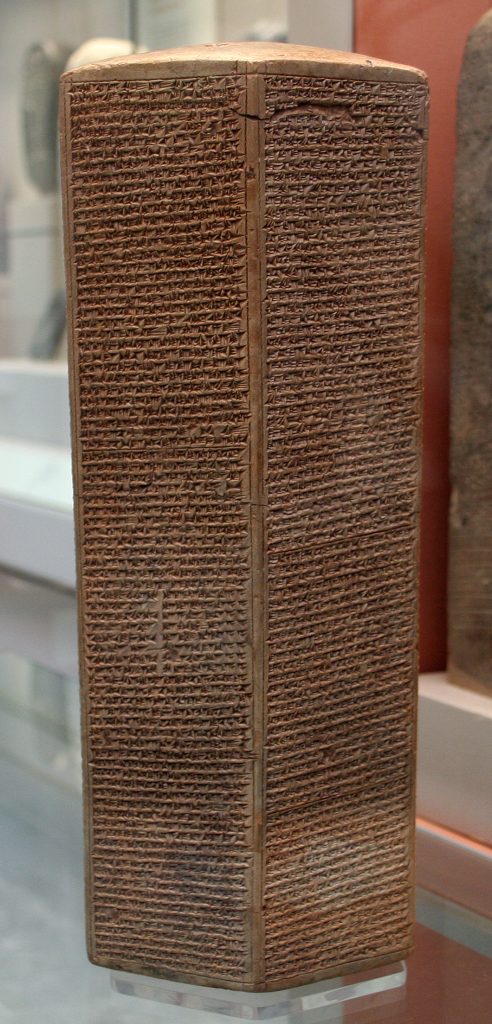
The Taylor Prism gives an Assyrian account of the campaign and names Hezekiah. Sennacherib claims to have taken a number of fortified towns and shut the Judean king within Jerusalem. The prism helps locate the pressure on the capital historically. The name on it is a reference to Hezekiah during the campaign. It supplies no identification for the foundations in Area A. Na’aman has also considered whether Ahaz ordered the Broad Wall after the earlier threat from Rezin and Pekah recorded in 2 Kings 16:5. In one possible sequence, different lines in Jerusalem’s defenses would then belong to different kings. The city needed fortifications in more than one crisis. Na’aman on Ahaz, Hezekiah and alternative wall sequences.
Na’aman also discusses a difference between the layers below the wall and later evidence from the quarter. The excavators found no impressions of the royal lmlk stamp beneath the Broad Wall. These stamps occur on storage-jar handles and provide another way to compare late Iron Age deposits. Their absence is one clue in an argument about when the wall was built relative to the spread of the stamps. A missing type of object has to be read alongside the excavated pottery sequence and the places that were sampled. It carries a different kind of weight from a securely dated object sealed under the foundation.
Read Isaiah’s description in full
Isaiah 22 describes people counting Jerusalem’s houses and breaking some down to fortify the wall. It is easy to see why this passage is so often read at the exposed Broad Wall. Archaeology gives us a specific place where the fabric of a city defense was laid over older houses. The passage gives us a description of construction that came at a cost to the city’s fabric. That close fit is worth noticing. Assigning the prophet’s words to a particular trench would require more evidence about the work he was describing. Isaiah 22:8–14.
Isaiah also asks readers to pay attention to the people’s response. They pay attention to breaches, look for arms and use water. The prophet charges them with failing to look to the One who made and planned it. Chronicles presents Hezekiah preparing the city and then telling its frightened people to take courage because the Lord is with them. The biblical accounts take the practical demands of a fortified city seriously and also speak to trust. Those are the words to keep reading after you have noticed the likeness between a verse and the exposed stones. Isaiah 22 · 2 Chronicles 32.
Continue around the city
The name Broad Wall evokes Nehemiah’s mention of a Jerusalem wall by that name during another period of restoration. That is a useful reminder that a city’s walls can be remembered, dismantled, repaired or given new names over time. The label on the excavated portion is a name modern readers can use to find it. Arguments about reuse after the monarchy and about which earlier walls Nehemiah encountered call for their own evidence. The same distinction helps when you move from the Broad Wall to the Siloam tunnel and its inscription. The city preserves defense and water works with differing relationships between structure, date and written testimony. Nehemiah 3:8.
Begin again with what you can see. A wide foundation runs across ground that had held houses. The excavated relationship preserves a change the residents would have known at close quarters. A historical comparison leads us to Hezekiah’s preparations and to earlier threats that also shaped the city. The biblical passages then take us from labor and fear to the question of where Jerusalem looked for help. With the stonework in mind, you can read those preparations as the actions of people whose city had room for both homes and walls, and whose lives changed when the two had to occupy the same ground.
Sources and further reading
- Hillel Geva, Jewish Quarter Excavations in the Old City of Jerusalem, volume I — Final report background. Area A architecture and stratigraphy, notably Avigad and Geva’s account of strata 9–7.
- Israel Antiquities Authority, Jerusalem, The Jewish Quarter (A) — Later excavation on the Western Hill in the context of the earlier Broad Wall and the later First Wall.
- Biblical Archaeology gazetteer, The Jerusalem Broad Wall — Excavated length, width, houses and site plans, with bibliographic references.
- Nadav Na’aman, Dismissing the Myth of a Flood of Israelite Refugees in the Late Eighth Century BCE — Zeitschrift für die alttestamentliche Wissenschaft 126 (2014), pp. 1–14. See the discussion of the Broad Wall, dating and possible royal builders.
- 2 Chronicles 32 and Isaiah 22 — Fortification work, the Assyrian threat, and the biblical messages about trust.