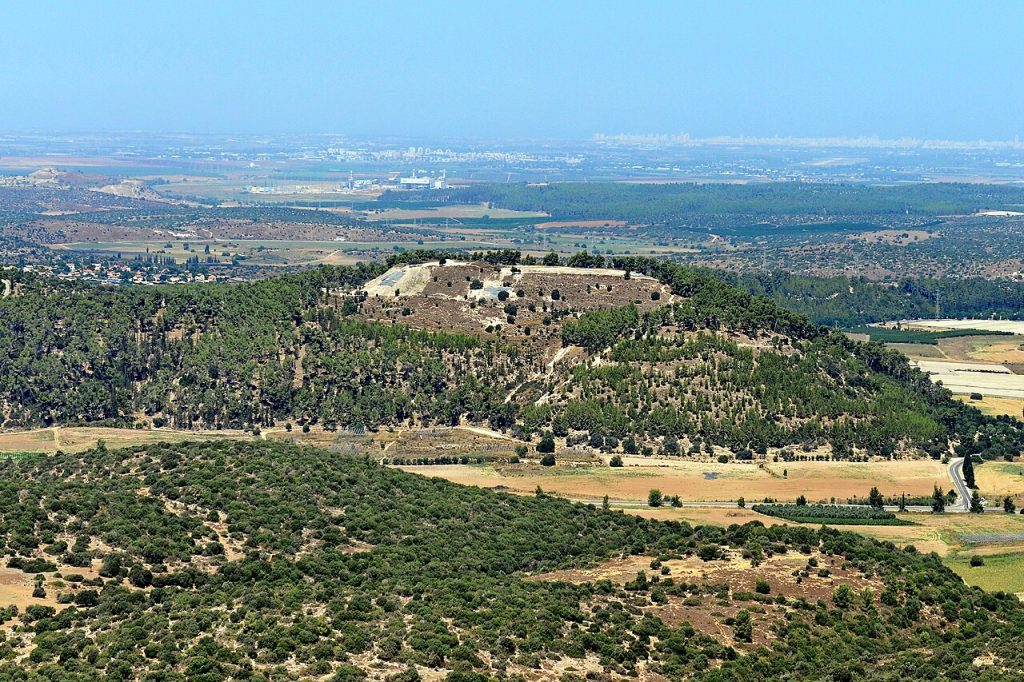
The first view of Tel Azekah explains why an Assyrian writer gave so much space to its height. The hill rises above the Elah Valley in the Shephelah, the belt of foothills between the coastal plain and Judah’s central highlands. From the summit you can see how far an approaching force would have to travel in the open. That advantage mattered to the people who depended on Azekah’s walls. It also mattered to the king who wanted his readers to believe that no wall could stand against him.
The inscription that names Azekah was probably recovered far away at Nineveh, in present-day Iraq. Most of the clay tablet is gone. Two pieces in the British Museum describe an Assyrian attack on the town and name Judah, but the passage containing the king’s identity has not survived. As Christians, we read the biblical history of Judah as true and accurate. We can therefore give the stone and clay their full attention, including details that remain open to question. The Assyrian words are particularly valuable for what they reveal about a town that Scripture remembers across several distinct periods. Read the cuneiform edition, no. 1015.
Key takeaways
- Two British Museum fragments preserve an Akkadian account naming Azekah and Judah. Nadav Na’aman published their join in 1974.
- The inscription describes a fortified hill town, its capture, and an attack on a second city in Philistia whose name is lost.
- Hezekiah’s conflict with Sennacherib in 701 BC is a strong historical fit. An earlier campaign under Sargon II remains a credible alternative because the Assyrian king’s name is missing.
- Joshua, 1 Samuel, and Jeremiah place Azekah in separate settings. Jeremiah’s Babylonian siege belongs more than a century after the proposed Assyrian attack.
How two tablet fragments became one text
The museum numbers are K 6205 and 82-3-23,131. The modern edition lists Kuyunjik at Nineveh as their probable provenance. K 6205 was already available in a published cuneiform copy in 1870. The second fragment also circulated separately in editions and studies. Early interpreters could make sense of individual phrases without seeing what continued at the edges. Some assigned the pieces to different kings. In 1974 Na’aman published the join and an edition that readers could compare with the earlier copies. That was the modern discovery of the combined text. The fragments themselves had been known for decades. Na’aman’s publication.
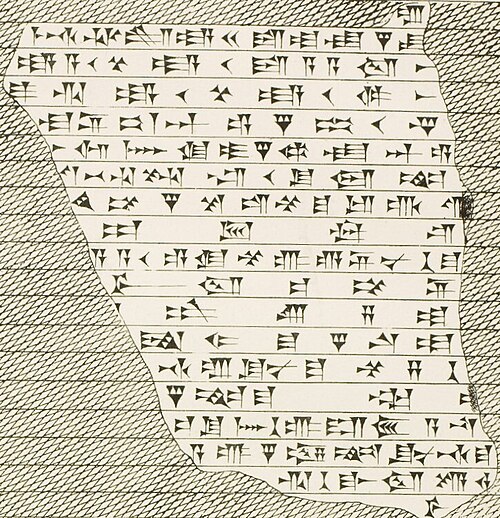
Think of two pieces of a handwritten letter torn diagonally. The words on one side only go so far. If the pieces belong together, a few lines can extend across the break and scattered clues may form a connected narrative. With Azekah, the combined account is longer, though most lines still have missing material. The modern editors print square brackets to distinguish writing that is lost, including words or names scholars propose restoring from the traces. The brackets matter most exactly where anyone hoping for a precise date wants the plainest answer. Even with both pieces the reverse is entirely missing from the surviving tablet. Transliteration and English translation, pp. 345–346.
The date of the surviving clay adds another question. Grayson and Novotny discuss whether it could be an archival copy written under a later king. They point to the particular way the scribes wrote the name of their god Ashur. Writing conventions overlap between reigns, so a spelling is one clue alongside the historical content and the language. A later copy would preserve a story about a campaign while belonging to a different moment in the history of the royal archive. Even the familiar description of the text as a letter to a god is a genre proposal. The editors leave room for a royal campaign account of another kind. Catalogue and commentary, pp. 344–345.
What the Assyrian account claims
The name written in Akkadian appears as Azaqā. The account puts the town next to Judah and describes it as a place on which its defender relied. Its well-fortified elevation dominates the description. The royal speaker goes on to claim victory, plunder, destruction, and burning. Later lines introduce a royal city in Philistia that a ruler commonly understood to be Hezekiah had seized and fortified. The second city’s name is missing. A named location in one paragraph and a damaged name in the next should receive different levels of confidence. Read lines 4–21 in the scholarly translation.
The text spends time on defenses because describing a hard objective makes the royal achievement sound greater. It gives the credit to the Assyrian king and Ashur. We can learn from the interest in Azekah and the reported outcome while recognizing how this kind of account selects and presents events. Consider what the writer leaves almost entirely outside the story. He tells us why a city was difficult to take. He gives us little sense of the everyday lives of the families who depended on that city for a home. Facing that silence is part of reading a history written for a conqueror.
Sennacherib or Sargon II?
Na’aman associated the text with Sennacherib’s third campaign, usually dated to 701 BC. In 2 Kings 18, Hezekiah asserts independence from Assyria, strikes Philistine territory as far as Gaza, and later faces Sennacherib’s invasion. Sennacherib’s own annals report that he took numerous fortified towns of Judah. An Assyrian account that describes an assault on a Judahite stronghold and an operation against a Philistine city formerly seized by the king of Judah fits that wider sequence. The excavators at Azekah likewise place a late-eighth-century destruction of the Judahite town in Sennacherib’s campaign. The fit is historical and geographical, with the Scripture, the campaign texts, and the site each contributing something. Na’aman on the campaign. The excavation report.
Gershon Galil argues for Sargon II and an earlier western campaign. Scholars who assign the tablet to Sargon have pointed to its language and to the fit with his military activity in Philistia. Even among those who prefer Sargon, historians have proposed different years. This helps explain why the editors place the text with possible inscriptions of Sennacherib while leaving both royal attributions open. Another piece preserving the king’s name, or a better dated parallel for the account, could substantially improve the case. Sennacherib remains a persuasive reading, with an independent secure reference point in the Lachish reliefs. Sargon’s own records and their connections to Scripture are worth reading alongside it in our article on Sargon II and Khorsabad. Galil’s alternative proposal.
Even a good fit between a text and an excavation deserves a close look. When excavators find broken vessels lying on floors beneath masonry or ash, they can study how the debris accumulated and whether the pieces were left there at the same time. The shapes of the pottery help place that layer in a regional sequence. Dating the layer to a span that includes a known campaign makes that campaign a candidate for the destruction. A campaign date becomes more compelling when the pottery, site history, written records, and comparisons with nearby towns converge. Where the composition of a tablet is debated, its historical attribution is still a separate question. The tablet and the layer can illuminate each other even when each has limits. See the excavators’ reconstruction of the Iron Age town.
The comparative advantage of Lachish is particularly clear. Its relief scenes are accompanied by a label that names the captured city and presents Sennacherib as the king. His campaign annals also name Hezekiah and portray him confined in Jerusalem, among claims about tribute and conquered cities. At Azekah, the city name is relatively clear while the king’s identity is reconstructed from the surrounding evidence. A student meeting these sources for the first time can sort them by the question each answers. Who is the Assyrian king? Where did the campaign lead? How did the two sides present the outcome? One artifact may answer the first two readily, while its purpose gives it very little reason to answer the last one from its opponent’s side.
Azekah was a place where Judah’s people lived through the rivalries that royal inscriptions tell from a throne.
The town Scripture remembers
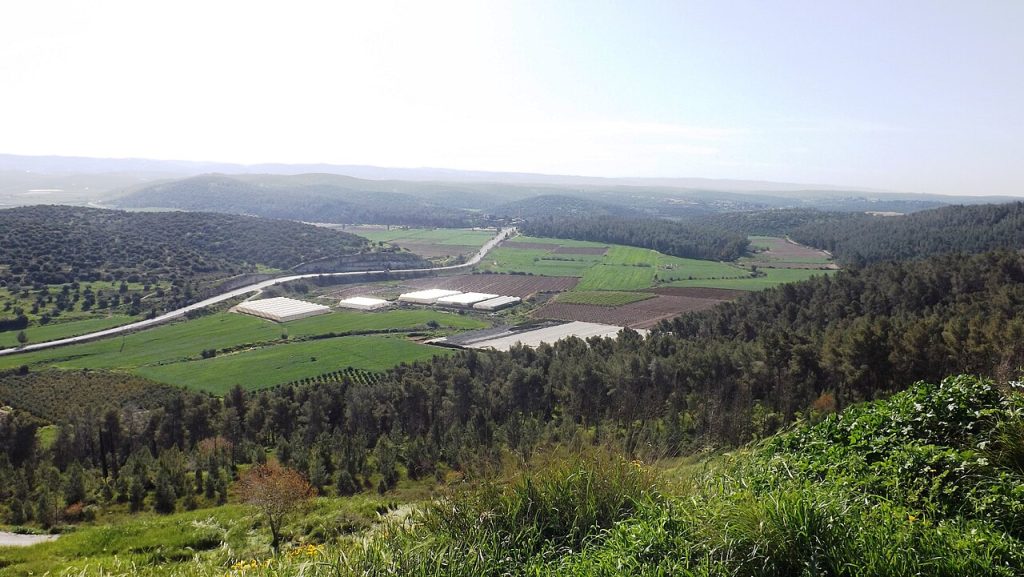
In Joshua 10:5–11, the allied kings attack Gibeon, Israel pursues them, and the flight takes them in the direction of Azekah and Makkedah. The reference uses the town to mark a direction across real country. In 1 Samuel 17:1–3, the Philistines camp between Socoh and Azekah, while Israel gathers in the Elah Valley. Reading those verses beside a view from the hill makes it easier to follow the movements of the two groups. The inscription comes from a later political landscape in which the kings of Judah and Assyria contend for the same frontier. Its geographical connection to Joshua and Samuel is the continuing significance of the place.
Jeremiah 34:1–7 looks across that same frontier in the sixth century BC. The king confronting Jerusalem this time is Nebuchadnezzar of Babylon. Jeremiah names Lachish and Azekah as the remaining fortified towns of Judah in that passage. The Lachish Letters offer a different kind of window into that period. In Letter IV a Judahite reports watching for signals from Lachish and being unable to see Azekah. The reason for the lack of visibility is open to interpretation. The writer’s names for the two places and concern with communications make a striking comparison with the two towns named in Jeremiah. At Azekah, the field team reports evidence of renewed settlement after the Assyrian destruction it associates with 701 BC. Towns on the frontier could be rebuilt and threatened all over again. See the field team’s proposed sequence.
The distinction among these passages helps me hear them more clearly as a Christian. The movements around Azekah in Joshua, the vulnerability of Judah’s towns in Kings, and the siege in Jeremiah belong to different generations of God’s people. Hezekiah’s prayer in 2 Kings 19:14–19 speaks of what the Assyrians had actually done to other lands. He lays the threat before the Lord with an awareness of the empire’s real power. The town’s strategic position and the Assyrian appetite for control help explain why that prayer had such urgency. Scripture gives us an account in which Judah’s security depended on the living God even when its fortified towns had fallen.
Keep the evidence in its place
- The clay: Two pieces probably recovered at Nineveh contain a royal account naming Azekah and Judah.
- The site: Excavations at Tel Azekah document a long-lived settlement. Researchers compare its changes in occupation with events reported in written sources.
- The biblical passages: Scripture uses Azekah’s location in several settings. The Babylonian siege in Jeremiah is a separate episode from Assyrian campaigning.
What would settle the identity of the Assyrian king?
A fragment that joins the tablet and preserves a royal name could answer the question directly. A fuller version of the same campaign account with a secure date might also do it. The place names and surviving campaign details currently support more than one reconstruction.
Sources and further reading
- Nadav Na’aman, “Sennacherib’s ‘Letter to God’ on His Campaign to Judah” (1974) — The join of the British Museum fragments, proposed readings, and case for the campaign of 701 BC.
- A. Kirk Grayson and Jamie Novotny, RINAP 3/2, inscription 1015, pp. 344–346 — Current scholarly edition used here for text, catalogue details, and alternative attributions.
- Gershon Galil, “A New Look at the ‘Azekah Inscription’” (1995) — The case for assigning the text to a campaign of Sargon II.
- Oded Lipschits, Yuval Gadot, and Manfred Oeming, Four Seasons of Excavations at Tel Azekah — The field team summarizes the site’s setting, excavation history, proposed Iron Age sequence, and historical interpretation.
- Tel Aviv University, Azekah excavation project — Institutional overview of the site, renewed excavations, and connection with Judah.





